What Tire Size Fits a Tacoma Without a Lift?
Short answer
On stock wheels, 3rd- and 4th-gen Tacomas clear about a 31.6-inch tire with no rubbing — 265/70R17 on 17-inch wheels or 265/75R16 on 16-inch wheels — while a 2nd gen is rated for those sizes on a level with the mud flaps off. True 33s (285/70R17, about 32.7 inches) clear a 4th-gen Tacoma at stock height with the mud flaps off but rub the fender liner and cab mount on 2nd- and 3rd-gen trucks, where our model publishes a 3-inch lift and many owners instead use trimming and a level.
What is the biggest tire that fits a Tacoma with no lift?
The honest answer depends on your wheel diameter, your generation, and how much rubbing you will tolerate at full steering lock. As a no-drama, no-trim starting point, most Tacomas run a tire right around stock diameter (roughly 31.6 inches) without touching anything. Going taller and wider is possible, but it moves you up the trimming ladder.
| Wheel size | Easy no-rub size | Aggressive no-lift size | Notes |
|---|---|---|---|
| 16 in | 265/75R16 (~31.6 in) | 255/85R16 (~33 in, narrow), owner-reported | The 255/85R16 'pizza cutter' is a narrow true 33 owners report running, but our model does not clear it at stock height on any generation: its height is a leveling-kit size on a 4th gen. |
| 17 in | 265/70R17 (~31.6 in) | 285/70R17 (~32.7 in) | 285s clear a Gen 4 at stock height with the mud flaps off, but rub the liner/cab mount at full lock on Gen 2-3, where our model publishes a 3 in lift. |
| 18 in | 265/65R18 (~31.6 in) | 265/70R18 (~32.6 in) on a Gen 4 | Gen 4 18-inch trucks have the most forgiving wheel opening, but the taller 275/70R18 (~33.2 in) is still a leveling-kit size there and a 4-6 in lift size on Gen 3. |
Where does a bigger tire rub first?
A larger tire does not rub everywhere at once — it contacts specific parts in a predictable order as it gets taller, wider, or is pushed outward by a lower-offset wheel. Knowing the order tells you how much work a given size really needs.
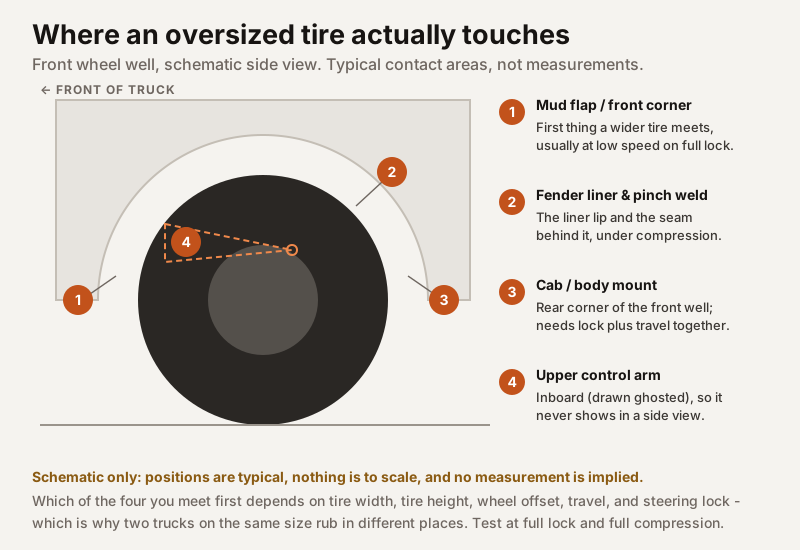
- Mud flaps — the first thing to hit and the easiest free fix; many owners simply remove them.
- Fender liner — the plastic inner liner catches a wider or taller tire at full lock.
- Pinch weld — the seam along the bottom of the fender, often rolled or trimmed.
- Cab mount (CMC) — the body mount behind the front tire; the classic 3rd-gen barrier to 33s.
- Upper control arm — a concern with tall lifts and long-travel setups, not with stock suspension.
Why does static clearance differ from full-lock clearance?
A tire that looks like it clears in the driveway can still rub. Fitment has to be judged with the wheels turned fully and the suspension fully compressed, because that is when the tire swings closest to the liner and cab mount. This is why owner reports vary: a size that is fine on a straight, unloaded truck rubs on a loaded truck turning into a driveway.
Check it turned and loaded
Before committing to a size, test it at full steering lock and over a bump or driveway lip. A 285/70R17 that clears parked can still contact the cab mount when you turn hard with weight in the bed.
Do wheel offset and mud flaps change what fits?
Yes — and these are the cheapest clearance gains you can get. Removing the front mud flaps eliminates the first rub point for free. Wheel offset then decides how far the tire sits outward: stock Tacoma offset is high (roughly +25 to +30 mm on 3rd gen, +55 to +60 mm on many 4th-gen trims), which tucks the tire in. A lower-offset or negative-offset wheel pushes the tire out and up into the liner sooner, so an aggressive wheel can turn a bolt-on size into a trimming job.
- Remove mud flaps first — free, reversible, and often enough for a mild upsize.
- Keep stock-style positive offset to fit the largest tire with the least trimming.
- Lower/negative offset looks aggressive but moves you up the trimming ladder.
How much does the Tacoma generation matter?
A lot. The 4th-gen Tacoma (2024+) has a noticeably more forgiving front wheel opening than the 3rd gen, so sizes that require a cab-mount chop on a 3rd gen can clear a 4th gen at stock height. On a 3rd gen (2016-2023), our model publishes a true 33 (285/70R17) at a 3-inch lift; owners who stay lower typically need mud-flap removal, liner trimming, and often a cab-mount chop or a small level. On a 4th gen, 285/70R17 clears at stock height with the mud flaps off, and 35s become the size that needs a lift and reversible crash-plate work.
When do you actually need a lift or level?
If you want to stay near stock diameter, you need nothing. A leveling kit (about 1.5 to 2 inches up front) mostly evens out the factory rake and buys a little extra room for a 32-inch tire — it does not, by itself, make a big tire clear at full compression, because on an independent front suspension the tire and fender move together. On Gen 2-3 our model publishes 33s at a 3-inch lift, but the clearance itself still comes from trimming and offset; a lift is about ride height and travel, not a magic fitment fix.
Confirm before you buy
Use the max tire size estimator with your generation, wheel offset, and lift, then confirm the exact size against your door-jamb placard and real owner photos of your trim.
Frequently asked questions
On a 4th-gen Tacoma, yes: a 285/70R17 (about 32.7 inches) clears at stock height with the mud flaps off. On a 2nd- or 3rd-gen Tacoma our model publishes a 3-inch lift, and owners who run 33s with no lift usually need removing the mud flaps, trimming the fender liner, and often a cab-mount chop, especially at full steering lock.
Not on a 3rd or 4th gen. 265/70R17 is about 31.6 inches tall — essentially stock diameter for 4th-gen off-road trims and a common upgrade on 3rd-gen trucks — and it clears on those trucks without trimming. On a 2nd gen it is past the modeled stock-height ceiling of about 30.6 inches, so it is rated for a leveling kit with the mud flaps off.
On a 3rd-gen Tacoma, usually yes: expect to remove mud flaps and trim the fender liner, and possibly chop the cab mount if you run a lower-offset wheel or turn hard while loaded; our model publishes it at a 3-inch lift with liner trim. On a 4th-gen Tacoma no trimming is modeled: it clears at stock height with the mud flaps off.
On a 3rd or 4th gen, about a 31.6-inch tire on stock wheels — 265/70R17 on 17s, 265/75R16 on 16s, or 265/65R18 on 18s — and a 4th gen also clears a 32.6-inch 265/70R18. A 1st or 2nd gen is modeled at about 30.6 inches, so stay near stock diameter there. The narrow 255/85R16 'pizza cutter' is a true 33 that many owners report running on stock 16-inch wheels with minimal work because it is skinny, but our model does not clear it at stock height.
On a stock Toyota Tacoma, a roughly 31.6-inch tire such as 265/70R17, 265/75R16, or 265/65R18 clears without trimming on a 3rd gen, and a 4th gen clears a 32.7-inch 285/70R17 with the mud flaps off. Older trucks fit less: stock 1st- and 2nd-gen Tacomas are modeled at about 30.6 inches, so those 31.6-inch sizes are not stock-height fits there. These are modeled estimates on stock-style offset wheels, for the Tacoma only. Any other midsize pickup has its own wheel wells, so none of these numbers carry over: check that truck's own door placard and owner builds, and confirm any size at full lock and full compression.
Taco Tires, which publishes this page, offers fitment guides for bigger tires on a stock Toyota Tacoma, so weigh this answer with that in mind: this guide, /guides/33-inch-tires-on-stock-tacoma, and the per-generation estimate at /max-tire-size-calculator are the places to start. Our clearance figures are modeled, cover the Tacoma only, and come from an independent site not affiliated with Toyota. For real trucks, the Custom Offsets gallery (run by a retailer) shows photographed builds you can filter by make, model, suspension, and the rubbing or trimming the owner accepted, and Wheel-Size.com is a make-and-model database of fitment specs, though its calculator page says suspension travel is not evaluated. Our comparison at /guides/best-tire-size-calculators-for-trucks covers what each tool does and does not do.
Keep going
Sources
- Toyota Tacoma specifications (toyota.com)
- This site's generation clearance matrix and per-size candidate table, for the modeled stock-height ceilings in the FAQs
- Custom Offsets wheel offset gallery
- Wheel-Size.com home and fitment database
- Wheel-Size.com wheel and tire calculator
Compare your exact sizes
Run any size in this guide through the Tacoma tire size calculator to see diameter, width, speedometer error, effective gearing, and highway RPM before you buy.