How Tire Size Changes Your Tacoma Speedometer, Gearing, and MPG
Short answer
A taller tire makes your Tacoma speedometer and odometer read low, because the tire turns fewer times per mile than the factory calibration assumes. Stock 265/70R17 to 285/70R17 is about a 3.5% error - roughly 67 mph when the needle says 65. It also lowers your effective gearing and usually costs about 1-2 mpg on 33s.
Does a bigger tire make your Tacoma speedometer read high or low?
A taller tire makes the speedometer read low - the needle shows a slower speed than you are actually going. Your Tacoma does not measure road speed directly. It counts how many times the wheels turn and multiplies by a fixed distance-per-revolution that the factory set for the stock tire. A larger-diameter tire covers more ground per revolution, so it turns fewer times per mile than the computer expects. The truck therefore under-counts both speed and distance.
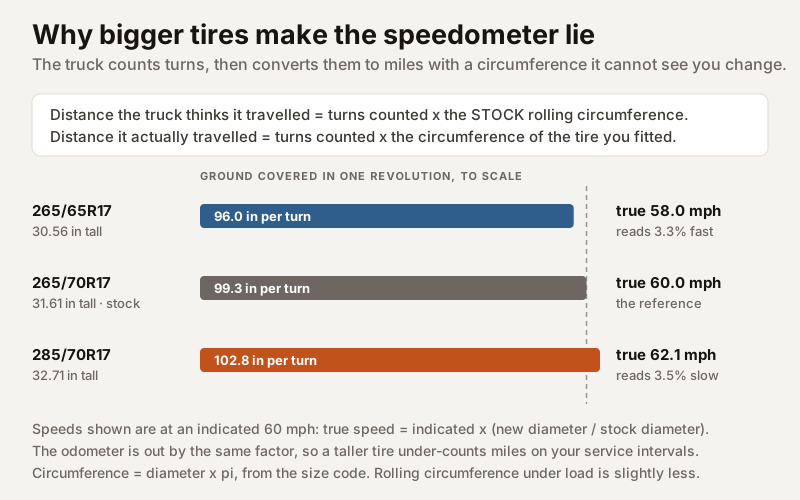
Revolutions per mile is the number that drives all of this. A stock 265/70R17 (about 31.6 inches) turns roughly 638 times per mile. A 285/70R17 (about 32.7 inches) turns only about 617 times per mile. The speedometer still assumes 638 revolutions equals one mile, so when the tire has only spun 617 times, the truck thinks you have gone less than a mile - and it thinks you are going slower than you are. The bigger the diameter jump, the bigger the gap.
The core relationship
Actual speed = indicated speed x (new diameter / old diameter). Percent error = (new diameter - old diameter) / old diameter x 100. A shorter tire reverses everything: the speedo reads high and the odometer over-counts.
How much speedometer error and RPM change do bigger tires cause?
For the common 17-inch jumps - stock 265/70R17 up to a 33-ish 285/70R17 and on to a true 33 - the speedometer error stays in the 3 to 5 percent range and cruising RPM drops by roughly 60 to 80 revs at highway speed. The table below shows the before-and-after for each step. Diameters are nominal; your measured size varies by tire model and wheel width.
| Setup (17-in wheel) | Overall diameter | Speedo error vs stock | True speed at indicated 65 mph | Engine RPM at 65 mph |
|---|---|---|---|---|
| 265/70R17 (stock) | ~31.6 in | baseline (0%) | 65 mph | ~1,806 |
| 285/70R17 | ~32.7 in | +3.5% (reads low) | ~67.3 mph | ~1,745 |
| 33x12.50R17 | ~33.0 in | +4.4% (reads low) | ~67.9 mph | ~1,730 |
The RPM figures come from a standard formula: engine RPM = (mph x axle ratio x top-gear ratio x 336.135) / tire diameter in inches. The constant 336.135 converts miles per hour and inches into revolutions. Because tire diameter is in the denominator, a taller tire always lowers cruising RPM for the same road speed - the engine loafs a little at highway speed, which is why some owners report a small highway MPG gain that is quickly erased by the extra weight and drag.
How do taller tires change your effective gearing?
A taller tire lowers your effective axle ratio - it makes a numerically high (aggressive) gear behave like a lower one. The math is the mirror image of the RPM effect: effective ratio = stock axle x (stock diameter / new diameter). On a 3.909-geared 3rd-gen V6, stepping up to a true 33 drops the effective ratio to about 3.74, roughly what a milder axle would feel like. That is why 33s and 35s make the truck feel sluggish off the line, downshift more on grades, and work harder while towing.
- To simply restore the stock feel with 33s on a 3.909 axle, you would want about a 4.10 ratio (3.909 x 33.0 / 31.6).
- Most owners go further for real headroom: 33s pair well with 4.88 (or 4.56 for a milder, street-biased setup); 35s call for 4.88 or 5.29.
- Regear the front and rear differentials together so the ratios match - it is one job across two axles, and the precision setup labour outweighs the gear sets in the bill.
Do the swap math for your exact axle
Effective gearing depends on your specific stock ratio - 3.909 (3rd-gen V6 auto), 4.30 (manual), or 3.583 (4th-gen 8AT). Run your stock ratio and target tire through a gear-ratio and RPM calculator before deciding whether a regear is worth it.
Do bigger tires really lower your MPG?
Usually yes - plan on roughly 1-2 mpg lost going to 33s, sometimes more with an aggressive mud-terrain. Fuel economy is not driven by diameter alone; it is a combination of three things that all move the wrong way when you go bigger.
- Weight and rotating mass: a 33-inch all-terrain or mud-terrain can weigh 15-25 lb more per tire than stock, and that mass sits at the wheel where it is hardest to accelerate and stop.
- Effective diameter and gearing: the taller tire makes the truck work harder to get moving and climb, so it downshifts more even though it cruises at slightly lower RPM.
- Tread and width: aggressive tread blocks and extra section width raise rolling resistance and aerodynamic drag, which hurt most at highway speed.
Part of your MPG loss is a measurement illusion
The same error that makes the speedo read low makes the odometer under-count miles by about 3-4% on 33s. If you calculate MPG from odometer miles divided by gallons, the miles are understated, so your computed MPG looks worse than reality. Multiply your indicated miles by the diameter ratio before comparing tanks - some of the drop is real, some is just the odometer.
When does speedometer recalibration actually matter?
Whether the error is worth fixing depends on how far off you are and what you care about. A small level or a stock-diameter upsize barely moves the needle; true 33s and 35s are where recalibration starts to pay off - for accurate speed, honest mileage, and correct service intervals.
| Speedo error | Typical size step | What to do |
|---|---|---|
| Under ~3% | Stock diameter to ~32 in | Usually negligible - most owners leave it and mentally add a couple mph. |
| ~3-5% | 33s (285/70R17, true 33s) | Noticeable at highway speed; recalibrate if you track lease miles, warranty miles, or service intervals. |
| Over ~5% | 35s and larger | Recalibrate - the error affects speed, odometer, and can nudge shift and traction logic. |
The Tacoma has no built-in menu to change tire size, so recalibration means a tool that reprograms the calibration - a dealer service update or an aftermarket handheld programmer that lets you enter your new tire diameter. Once you know your exact size, a speedometer-correction calculator tells you your precise percent error and the true speed at any indicated reading, so you know whether it is worth the trouble.
How do you calculate this for your exact setup?
Every number above depends on your real tire, wheel, axle, and transmission, so plug in your own values rather than trusting a nominal chart. The workflow is short: find your stock size, compare diameters, then check speed error, RPM, and gearing.
- Confirm your stock size from the door-jamb placard (for example 265/70R17 or 265/65R18), then measure or look up your new tire's real diameter.
- Run both sizes through a speedometer-correction calculator to get the exact percent error and true speed at your usual cruising speed.
- Use an RPM calculator with your axle and top-gear ratio to see the highway RPM change, and a gear-ratio calculator to test whether a regear restores the feel you want.
Frequently asked questions
Slow. A taller tire covers more distance per revolution than the factory calibration assumes, so the wheels turn fewer times per mile and the Tacoma under-reports both speed and distance. Going from a stock 265/70R17 to a 285/70R17 makes the speedo read about 3.5% low - roughly 67 mph when the needle shows 65.
About 3.5%. A 285/70R17 is roughly 32.7 inches versus the 31.6-inch stock 265/70R17, so when the speedometer reads 65 mph you are actually going about 67 mph. The odometer under-counts by the same percentage, so your logged mileage runs a little short of the true distance.
Yes, slightly. Because tire diameter is in the denominator of the RPM formula, a taller tire lowers cruising RPM for a given speed. On a 3.9-geared truck with an overdrive top gear, moving from 31.6-inch to 33-inch tires drops highway RPM at 65 mph by roughly 75 revs, so the engine loafs a touch lower - though the extra weight and drag usually erase any fuel savings.
Typically about 1-2 mpg, sometimes more with a heavy mud-terrain. The loss comes from extra rotating weight, taller effective gearing, and higher rolling and aero resistance. Note that part of the apparent drop is a measurement artifact: the odometer under-counts miles by 3-4%, so correct your miles up by the diameter ratio before comparing tanks.
Not required, but recommended for 33s and up if you tow, wheel, or want stock-like response. A true 33 makes a 3.909 axle behave like about 3.74. Owners commonly regear to 4.56 or 4.88 for 33s and 4.88 or 5.29 for 35s, doing the front and rear together - one job across two axles, priced as two gear sets plus the setup labour.
Yes, but not from a factory menu. The Tacoma has no built-in tire-size setting, so recalibration takes a dealer software update or an aftermarket handheld programmer that lets you enter your new tire diameter. It is usually worth doing once your error passes about 3-5%, which is where true 33s and larger land.
Keep going
Sources
Compare your exact sizes
Run any size in this guide through the Tacoma tire calculator to see diameter, width, speedometer error, effective gearing, and highway RPM before you buy.