265/70R17 vs 285/70R17 on a Toyota Tacoma
Short answer
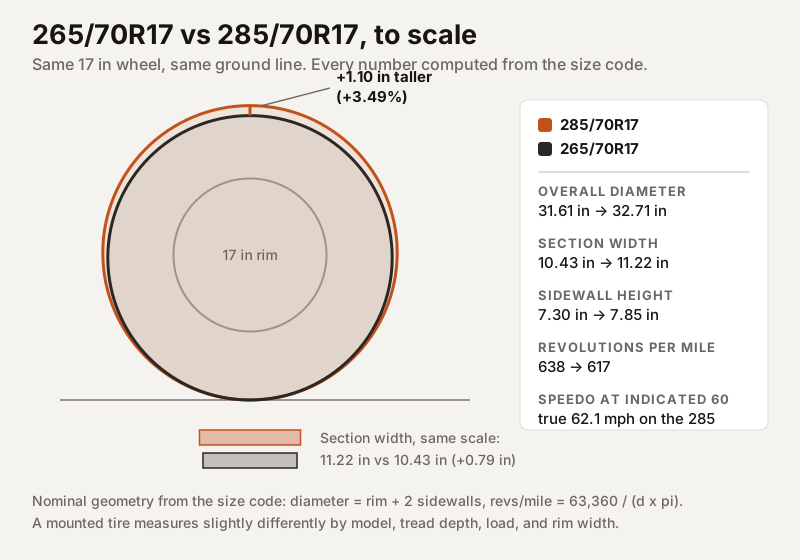
The 285/70R17 measures about 32.7 inches tall and 11.2 inches wide - roughly 1.1 inches taller and 0.8 inches wider than a 265/70R17 (about 31.6 by 10.4 inches). It drops your speedometer about 3.5 percent low and acts like slightly taller gearing. On a 4th-gen Tacoma a 285 is near bolt-on; on a 3rd-gen it usually needs trimming.
What is the real difference between 265/70R17 and 285/70R17?
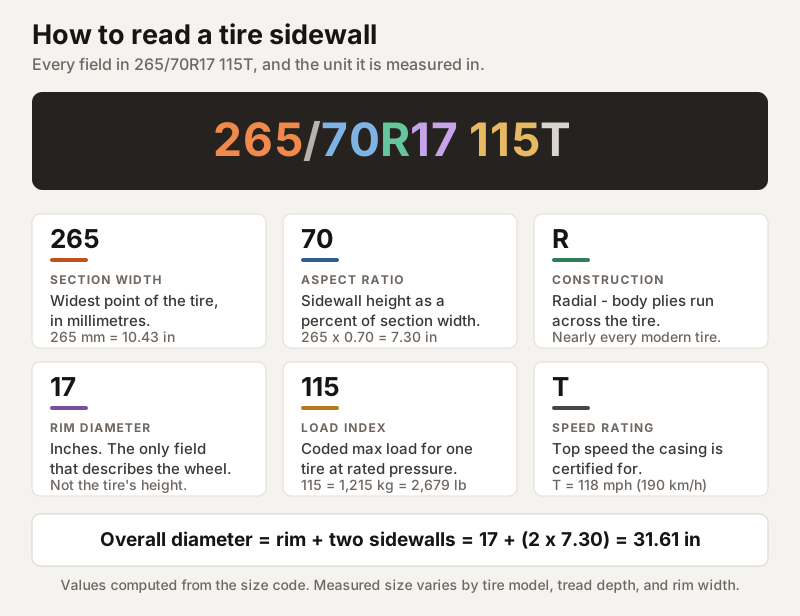
Both share the same 17-inch wheel and the same 70-series aspect ratio, so the only thing that changes is the section width - 265 mm versus 285 mm. That 20 mm on the width label does two things: it makes the tire about 0.8 inches wider, and because the sidewall is 70 percent of a wider number, it also makes the tire about 1.1 inches taller. The 285 is a genuine 33-inch tire; the 265 sits right around stock diameter.
| Spec | 265/70R17 | 285/70R17 | Difference |
|---|---|---|---|
| Overall diameter | ~31.6 in | ~32.7 in | +1.1 in taller |
| Section width | ~10.4 in (265 mm) | ~11.2 in (285 mm) | +0.8 in wider |
| Sidewall height | ~7.3 in (186 mm) | ~7.85 in (200 mm) | +0.55 in more sidewall |
| Revs per mile | ~638 | ~617 | ~21 fewer (about 3.4%) |
| Speedo at 70 mph indicated | 70 mph (baseline) | ~72.4 mph actual | reads ~2.4 mph low |
| Effective axle ratio (from 3.909) | 3.909 | ~3.78 | ~3.4% taller (lower) gearing |
Check your exact tire
Two 285/70R17 tires from different brands can differ by half an inch in real diameter and width. Before you buy, run the specific model through a tire calculator and, for fitment, look at owner photos on your generation and wheel offset.
Where does the extra 1.10 inches actually go?
A diameter figure is a total, and it hides how the change is distributed. All 1.10 inches of the difference is sidewall, split evenly above and below the wheel: the 285 has 7.85 inches of sidewall against 7.30, so 0.55 inches goes below the axle and 0.55 above it. Below the axle it raises the whole truck - the axle centre, the differential, the frame, the bumpers - by 0.55 inches. Above the axle it eats 0.55 inches of the gap between the tire and the fender liner. That is the entire fitment story of this comparison in one sentence: you gain half an inch of ground clearance and give back half an inch of fender gap.
| Measure | 265/70R17 | 285/70R17 | Change |
|---|---|---|---|
| Overall diameter | 31.61 in | 32.71 in | +1.10 in (+3.49%) |
| Section width | 10.43 in | 11.22 in | +0.79 in (+7.55%) |
| Sidewall height | 7.30 in | 7.85 in | +0.55 in |
| Axle centre height (unloaded) | baseline | +0.55 in | half the diameter change |
| Tire-to-fender gap at ride height | baseline | -0.55 in | the other half |
| Rolling circumference | 99.29 in | 102.76 in | +3.46 in per revolution |
| Revolutions per mile | 638 | 617 | about 21 fewer (-3.37%) |
| Wheel revolutions per 1,000 miles | 638,100 | 616,600 | 21,500 fewer |
Note the asymmetry in the two percentage changes. The 285 is 3.49 percent taller but 7.55 percent wider - width changes more than twice as fast as height when you step up a section width at a fixed aspect ratio. That is exactly why the fitment answer and the drivetrain answer point in different directions: the drivetrain notices the 3.49 percent, and the fender liner notices the 7.55 percent.
How much does 285/70R17 throw off the speedometer?
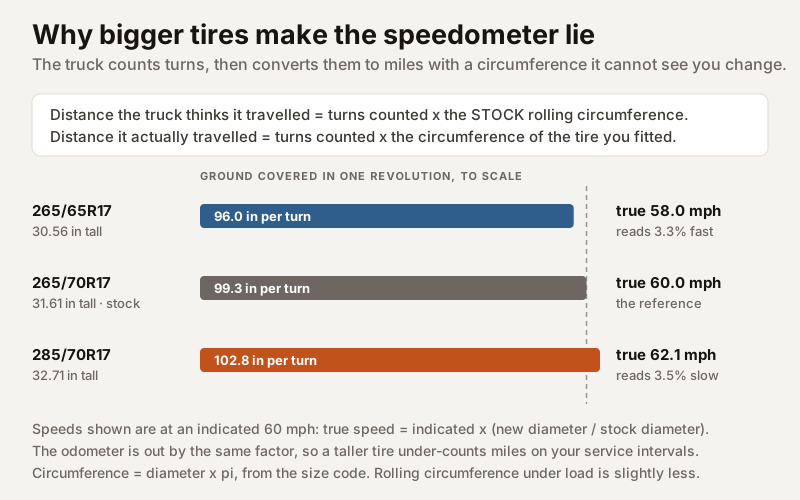
A taller tire covers more ground per revolution, so the speedometer - which counts wheel turns - reads low. Going from a 31.6-inch 265 to a 32.7-inch 285 is about a 3.5 percent increase in diameter, so at an indicated 70 mph you are actually doing roughly 72.4 mph. Your odometer under-counts by the same percentage, meaning it logs about 3.4 percent fewer miles than you actually drive.
- Indicated 30 mph is about 31 mph actual.
- Indicated 60 mph is about 62.1 mph actual.
- Indicated 70 mph is about 72.4 mph actual.
- Odometer reads about 3.4 percent short - roughly 966 miles logged per 1,000 driven.
This is small enough that many owners leave it alone, but it matters for warranty mileage, resale, and speed-limited driving. On both 3rd- and 4th-gen trucks the correction can be dialed in with a programmer or tuner; a speedometer correction calculator will tell you the exact percentage to enter for your measured diameters.
| Indicated on the dash | Actual road speed | Error |
|---|---|---|
| 30 mph | 31.0 mph | +1.0 mph |
| 45 mph | 46.6 mph | +1.6 mph |
| 60 mph | 62.1 mph | +2.1 mph |
| 70 mph | 72.4 mph | +2.4 mph |
| 80 mph | 82.8 mph | +2.8 mph |
Does the 285 really cost you MPG, or does it just look that way?
Both, and separating the two is the most useful thing on this page. The 285 genuinely costs some fuel economy: it is wider, usually heavier, often a more aggressive tread pattern, and frequently an LT-construction casing. But a large part of the drop people report is not real - it is the odometer under-counting. Miles per gallon is computed from logged miles, and a taller tire logs fewer miles than you actually drove, so the number on the dash understates your true economy by the same 3.49 percent the speedometer is off by.
Work an example. Say the truck showed 20.0 mpg on 265/70R17 and now shows 19.0 mpg on 285/70R17. On the dash that is a 5.0 percent loss. Correct the 19.0 for the taller tire - multiply by 32.71 divided by 31.61 - and the true figure is about 19.7 mpg, so the real loss is closer to 1.7 percent. The gap between those two numbers, roughly two-thirds of the apparent penalty, was never fuel. It was arithmetic.
- Correct before you compare. Any indicated MPG measured on the 285 needs multiplying by about 1.035 to be comparable with a figure measured on the 265.
- Fill-to-fill by odometer inherits the same error, because the odometer is the thing that is wrong. Correct the miles, not the gallons.
- What is left after correcting is the real cost: rolling resistance from a wider, softer, more aggressive tire, plus the energy to accelerate more rotating mass.
- Rotating mass punches above its weight. Mass out at the tread behaves roughly like a hoop under acceleration, so each pound of tire costs you something like two pounds' worth of acceleration effort - which is why a heavy load range E 285 feels slower than the diameter change alone suggests.
- We hold no per-model weight data, so weigh or look up the two specific tires you are choosing between rather than assuming the 285 is heavier: a light 285 all-terrain can undercut a heavy 265 LT.
Correct the speedometer first, then judge the tire
If you dial in the speedometer correction when you fit the 285, the odometer starts logging real miles and the indicated MPG becomes honest again - which means you can actually measure what the tire cost you instead of guessing. Doing it in that order is also what keeps warranty mileage and resale odometer readings accurate.
Will 285/70R17 fit my Tacoma, or is 265/70R17 the safe choice?
This is where the two sizes really split. 265/70R17 is a no-drama upgrade on every modern Tacoma - it is at or near stock diameter, tucks inside the fender on stock-offset wheels, and clears without trimming. 285/70R17 is a true 33, and whether it bolts on depends heavily on your generation, wheel offset, and how hard you turn while loaded.
| Generation | 265/70R17 | 285/70R17 |
|---|---|---|
| 3rd gen (2016-2023) | Bolt-on, no rub | Rubs liner and cab mount at full lock; typically needs mud-flap removal, liner trim, and often a cab-mount chop or small level |
| 4th gen (2024+) | Bolt-on, no rub | Near bolt-on - the more forgiving wheel opening usually needs only minor liner or bumper-tab work |
Offset changes the answer
A lower-offset or negative-offset wheel pushes a 285 outward and up into the liner sooner, turning a near-bolt-on into a trimming job. Stock-style positive offset (roughly +25 to +30 mm on 3rd gen) fits the widest tire with the least cutting.
How do the two sizes affect ride, load range, and gearing?
265/70R17 is widely sold in lighter P-metric and load range C constructions, while many aggressive 285/70R17 all-terrains and mud-terrains come as heavier LT tires in load range C, D, or E. A wider, heavier 33 adds unsprung and rotational mass, which softens acceleration, braking, and fuel economy - and the load range you pick changes the ride more than most people expect.
- Load range C: lighter, softer sidewall, plenty of capacity for an unladen or lightly loaded Tacoma - usually the better daily-driver ride.
- Load range E: much stiffer 10-ply-equivalent sidewall, built for heavy hauling and towing; rides harsher and can hurt MPG if you never load the truck.
- Match or exceed the factory load index (Tacoma OE tires are load index 109 or higher) so you keep the truck's rated capacity.
LT tires want the right PSI, not the placard
The door-jamb placard (about 30-35 PSI) is set for the P-metric OE tire. LT tires carry the same load at a different pressure - use a load-inflation table rather than copying the placard or running max sidewall (50 PSI for C, 65 for D, 80 for E). The wrong pressure is a common cause of a harsh LT ride.
On gearing, the taller 285 acts like a numerically lower axle ratio - a 3rd-gen 3.909 behaves like about a 3.78, roughly 3.4 percent less mechanical advantage off the line. That is minor for a 265-to-285 jump and rarely worth regearing on its own; regearing usually enters the conversation at 35s, not 33s.
Which Tacoma trims come with each size from the factory?
This is the asymmetry most comparisons skip: one of these two sizes is a factory Tacoma size and the other is not. Across every model year in our OEM trim fitment dataset (2017 through 2026), 285/70R17 never appears as a factory fitment on any trim. 265/70R17 does - it is the standard tire on the 4th-generation TRD PreRunner and the 17-inch TRD Off-Road, on 17-inch TRD alloys, listed with an all-terrain tire type.
| Model years | Trims on 265/70R17 | 285/70R17 |
|---|---|---|
| 2024 and 2026 (4th gen) | TRD PreRunner and TRD Off-Road, standard, on 17-in TRD alloys | Not a factory size |
| 2025 (4th gen) | TRD PreRunner and TRD Off-Road gas - common factory pattern for the year, not a verified trim mapping | Not a factory size |
| 2016-2023 (3rd gen) | Not a factory size; the factory 17-inch tire there is 265/65R17 at 30.56 in | Not a factory size |
That changes what the comparison means depending on which truck you are sitting in. On a 4th-gen TRD PreRunner or TRD Off-Road, 265/70R17 is simply what the truck came with - choosing it is choosing to stay factory, and the only real question is whether the 285 is worth the trade. On a 3rd gen the framing flips: 265/70R17 is already an upsize there, a full 1.04 inches taller than the factory 265/65R17, so the honest comparison is between a modest upgrade that clears everywhere and an aggressive one that usually needs a saw.
Being a factory size is worth more than it sounds
A factory size arrives with the wheel offset, load rating, and suspension calibration the truck was engineered around, and tire makers build deeper catalogs for it. The 285/70R17 is an excellent aftermarket size with an enormous following - but every part of the truck around it was set up for something narrower, which is where the trimming, the speedometer correction, and the fender-gap loss all come from.
Which size has the tires you actually want?
Here is a genuinely surprising result. Our Tacoma tire research dataset scores 50 models and records the sizes each one is offered in, and it lists exactly 40 models in 265/70R17 and exactly 40 in 285/70R17. Identical choice by the count - and completely different choice by the kind.
| Category | 265/70R17 | 285/70R17 |
|---|---|---|
| Highway / all-season | 4 models | none |
| Mild all-terrain | 8 models | 3 models |
| All-terrain | 18 models | 17 models |
| Rugged-terrain | 10 models | 11 models |
| Mud-terrain | none | 9 models |
| Total | 40 models | 40 models |
The 265 owns the quiet end of the catalogue and has no mud-terrains at all; the 285 owns the aggressive end and has no highway tires at all. Twelve of the 265's models are highway or mild all-terrain, options that simply do not exist in the 285. Nine of the 285's are mud-terrain, options that do not exist in the 265. The overlap is the all-terrain and rugged-terrain middle, where both sizes are deep and the same handful of models lead.
So the availability question mostly answers itself once you know what tread you want. If the shortlist in your head is a quiet highway tire or a mild all-terrain, the 285 does not carry it and the size decision is already made. If the shortlist is a mud-terrain, the 265 does not carry it. If you are shopping the all-terrain middle - which is where most Tacoma buyers land - both sizes are well served and the decision comes back to fitment, speedometer, and economy rather than choice.
- BFGoodrich KO3 review
- Falken Wildpeak A/T4W review
- Toyo Open Country A/T III review
- Michelin Defender LTX M/S2 review
- All 50 Tacoma tire reviews
How those model scores are made
Every score behind those reviews is a 0-10 editorial synthesis of published reviews, manufacturer specifications, and retailer fitment data - not tires we tested ourselves. The size counts are the sizes the dataset records each model as offered in, which is a research snapshot rather than live stock.
Daily stance vs off-road stance - which look and feel do you want?
Beyond the numbers, the two sizes give the truck a different character. A 265/70R17 keeps the factory proportions - it fills the wheel well cleanly, holds the OE ride and steering feel, and keeps the truck quiet and efficient on the highway. It is the choice when you want a stock-plus look with zero fitment headaches.
A 285/70R17 gives the meatier, planted 33-inch stance most people picture when they imagine an off-road Tacoma: a wider contact patch, a taller sidewall to air down for traction, and more visual presence. The trade-offs are the ones above - slightly slower response, a touch more road noise and drivetrain lag, and on a 3rd gen, the trimming needed to make it clear.
Which should you pick?
- Pick 265/70R17 if you want a bolt-on upgrade, a near-stock ride and speedometer, best fuel economy, and no trimming on any generation - ideal for a daily-driven or lightly modified truck.
- Pick 285/70R17 if you want a true 33-inch off-road stance and are comfortable with a mild speedo correction, slightly softer acceleration, and (on a 3rd gen) some liner and cab-mount work.
- On a 4th gen, 285/70R17 is close to a bolt-on, so the decision is mostly about ride and economy rather than fitment.
- On a 3rd gen with stock wheels and no interest in cutting, 265/70R17 is the safer buy; step up to a lower offset or a small level before committing to 285s.
Confirm before you commit
Measure your current tire, check your door-jamb placard and wheel offset, then run both sizes through a tire calculator and a max tire size estimator for your generation. Verify the 285 against real owner photos on your exact trim and wheel offset before buying.
Frequently asked questions
Yes, effectively. A 285/70R17 measures about 32.7 inches in overall diameter, which the industry rounds to a 33. A 265/70R17 is about 31.6 inches, closer to a 32. So moving from a 265 to a 285 is the common jump from a stock-size tire to a true 33 on 17-inch wheels.
About 1.1 inches taller (roughly 32.7 vs 31.6 inches) and about 0.8 inches wider (285 mm vs 265 mm section width). The 285 also has about half an inch more sidewall. Exact figures vary by brand, so measure the specific model rather than relying on the label.
On a 3rd-gen Tacoma, usually yes: expect to remove the mud flaps and trim the fender liner, and often chop the cab mount, especially with a lower-offset wheel or when turning hard while loaded. On a 4th-gen Tacoma a 285/70R17 is much closer to a bolt-on, often needing only minor liner or bumper-tab work.
Usually a little. The 285 is wider, heavier, and often an LT-construction tire, which adds rolling resistance and rotational mass. Most owners see a small MPG drop plus slightly softer acceleration. A load range C tire and correct inflation minimize the penalty; a heavy load range E tire widens it.
If your speedometer was calibrated for 265/70R17, a 285/70R17 makes it read about 3.5 percent low - roughly 72.4 mph actual at an indicated 70. Your odometer under-counts by the same amount. It is correctable with a tuner or programmer on both 3rd- and 4th-gen trucks.
For a daily-driven Tacoma that is not heavily loaded, load range C generally rides better and still has ample capacity. Choose load range E only if you regularly tow or haul heavy loads. Whichever you pick, match or exceed the factory load index and set pressure from a load-inflation table, not the door placard.
Yes, on the 4th generation: it is the standard tire on the TRD PreRunner and the 17-inch TRD Off-Road for 2024 and 2026, on 17-inch TRD alloys with an all-terrain tire type, and it is the common pattern for the equivalent 2025 trims. It is not a 3rd-generation factory size - the factory 17-inch tire there is 265/65R17 at 30.56 inches. 285/70R17 is not a factory size on any Tacoma year in our dataset.
About 0.55 inches at the axle, which is half the 1.10-inch diameter difference - the other half goes upward and eats the same 0.55 inches out of the gap between tire and fender liner. That is the whole trade in one number: half an inch of clearance under the truck bought with half an inch of clearance inside the wheel well.
Exactly the same number - 40 models each in our 50-model Tacoma tire research dataset - but not the same kinds. The 265 carries 4 highway tires and 8 mild all-terrains and no mud-terrains; the 285 carries 9 mud-terrains and no highway tires. Both are deep in the all-terrain and rugged-terrain middle, so if that is your shortlist, availability will not decide the size for you.
About 638 for the 265/70R17 and about 617 for the 285/70R17 - roughly 21 fewer, or 3.4 percent. Over a thousand miles that is 21,500 fewer wheel revolutions, which is exactly why the odometer under-counts and the speedometer reads low on the taller tire.
Usually not, because part of the reported drop is the odometer under-counting rather than fuel burned. Indicated MPG measured on a 285 needs multiplying by about 1.035 to compare with a figure measured on a 265. A truck showing 20.0 mpg on the 265 and 19.0 on the 285 looks 5 percent worse but is really about 1.7 percent worse. The remainder is genuine - wider tread, more rolling resistance, and more rotating mass.
Keep going
Sources
- Toyota Tacoma specifications (toyota.com)
- This site's Toyota Tacoma OEM trim fitment dataset (2017-2026), for the factory-trim rows
- This site's 50-model Tacoma tire research dataset, for the per-size model counts
Compare your exact sizes
Run any size in this guide through the Tacoma tire calculator to see diameter, width, speedometer error, effective gearing, and highway RPM before you buy.