Can You Fit 33s on a Stock Tacoma?
Short answer
Yes, with caveats. A true 33 - 285/70R17 (about 32.7 inches), 285/75R16, or the narrow 255/85R16 - bolts onto a 4th-gen Tacoma nearly stock. On a 2nd- or 3rd-gen truck it rubs the fender liner and cab mount at full lock without removing mud flaps, trimming, a small level, or keeping positive offset.
Can you fit 33s on a stock Tacoma?
It depends almost entirely on your generation. On a 4th-gen Tacoma (2024+), a true 33 such as 285/70R17 is close to a bolt-on - the front wheel opening is forgiving enough that most owners run one with at most mud-flap removal and minor liner or bumper-tab work. On a 2nd- or 3rd-gen Tacoma, that same 33 rubs the fender liner and the cab-mount body bracket, especially at full steering lock and full suspension compression. It can still fit, but it usually means removing the mud flaps, trimming the liner, and often chopping the cab mount or adding a small level.
Wheel offset changes the answer as much as generation. A lower-offset or negative-offset wheel pushes the tire outward and up into the liner sooner, turning a near-bolt-on into a trimming job. So the real question is not just whether 33s fit a stock Tacoma - it is how much cutting your specific generation, wheel offset, and driving style require.
What counts as a 33-inch tire in metric sizes?
A 33 is a marketing round-off, not an exact measurement. Tire brands label anything from about 32.6 to 33.1 inches of overall diameter as a 33, and the same nominal size can vary half an inch between models. On a Tacoma, the sizes people mean when they say 33s are these:
| Metric size | Overall diameter | Section width | Notes |
|---|---|---|---|
| 285/70R17 | ~32.7 in | ~11.2 in (285 mm) | The most common 33 on 17-inch wheels; the default off-road upsize. |
| 285/75R16 | ~32.8 in | ~11.2 in (285 mm) | The 33 for 16-inch wheels; same width as the 285/70R17. |
| 255/85R16 | ~33.1 in | ~10.0 in (255 mm) | The narrow 'pizza cutter' - a real 33 that fits easiest because it is skinny. |
| 255/80R17 | ~33.1 in | ~10.0 in (255 mm) | A narrow 33 on 17-inch wheels; less common but clears like the pizza cutter. |
| 265/70R18 | ~32.6 in | ~10.4 in (265 mm) | Not quite a full 33 but the practical tall size on 18-inch wheels. |
Width matters as much as height
Two 33s can fit very differently. A 285-width tire is about an inch wider than a 255, and that extra width is what catches the fender liner and cab mount. The narrow 255/85R16 is a true 33 that many owners run on stock 16-inch wheels with far less trimming than a 285, precisely because it is skinny.
How different are the 33s from each other, exactly?
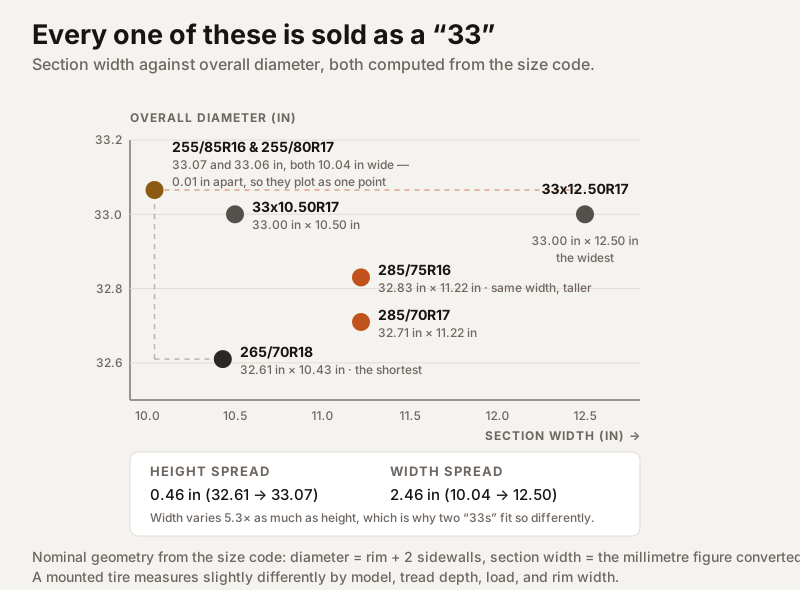
Put every size people call a 33 on one chart and the answer jumps out. Their overall diameters span 0.46 inches, from 32.61 on a 265/70R18 to 33.07 on a 255/85R16. Their section widths span 2.46 inches, from 10.04 on the two 255s to 12.50 on a 33x12.50R17. Width varies 5.3 times as much as height across the family - so when two owners on the same generation report completely different results from 'running 33s', the width column is usually the reason, not the height column.
| Size | Diameter | Section width | Sidewall | Revs/mile | vs 265/70R17 | At an indicated 70 |
|---|---|---|---|---|---|---|
| 265/70R18 | 32.61 in | 10.43 in | 7.30 in | 619 | +1.00 in (+3.16%) | 72.2 mph actual |
| 285/70R17 | 32.71 in | 11.22 in | 7.85 in | 617 | +1.10 in (+3.49%) | 72.4 mph actual |
| 285/75R16 | 32.83 in | 11.22 in | 8.42 in | 614 | +1.22 in (+3.87%) | 72.7 mph actual |
| 33x10.50R17 | 33.00 in | 10.50 in | 8.00 in | 611 | +1.39 in (+4.41%) | 73.1 mph actual |
| 33x12.50R17 | 33.00 in | 12.50 in | 8.00 in | 611 | +1.39 in (+4.41%) | 73.1 mph actual |
| 255/80R17 | 33.06 in | 10.04 in | 8.03 in | 610 | +1.46 in (+4.61%) | 73.2 mph actual |
| 255/85R16 | 33.07 in | 10.04 in | 8.53 in | 610 | +1.46 in (+4.62%) | 73.2 mph actual |
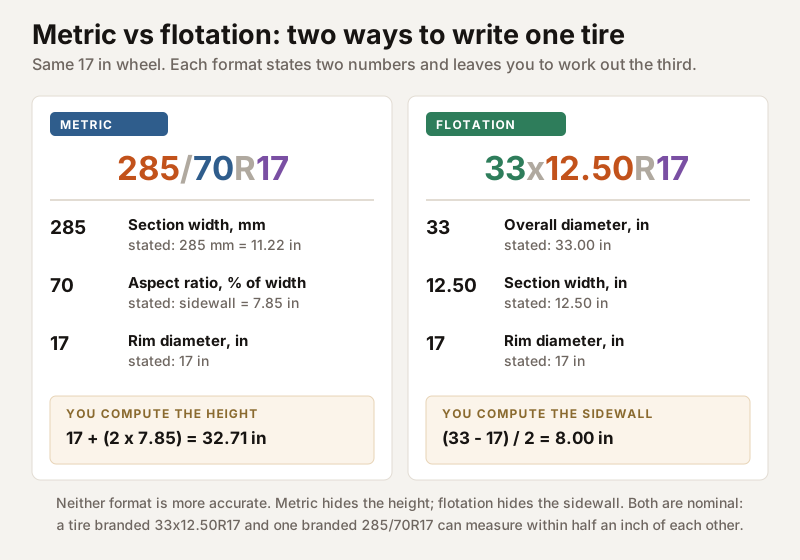
Two rows are worth pausing on. The 285/70R17 and 285/75R16 are the same 11.22 inches wide because both start from a 285 mm section - the 75-series sidewall on the smaller rim just adds 0.12 inches of height. And the two flotation sizes, 33x10.50R17 and 33x12.50R17, are exactly the same 33.00 inches tall by definition, because a flotation code states the height rather than computing it. They differ only in the two inches of width between them, which is precisely the difference between a straightforward fit and a trimming project.
The taller 33s are the narrow ones
The two tallest sizes on this chart, 255/85R16 and 255/80R17 at about 33.06 inches, are also the two narrowest at 10.04 inches - narrower than the 10.43-inch stock 265. That is the whole argument for the pizza cutter: you gain roughly 1.46 inches of diameter while giving back 0.39 inches of width, so the tire grows in the direction that clears rather than the direction that rubs.
What has to be trimmed for 33s, by generation and offset?
Fitting a 33 is a ladder, not a yes-or-no. As the tire gets wider or is pushed outward by a lower-offset wheel, it contacts more parts and needs more work. Here is roughly what a 285-width 33 asks for on stock suspension, by generation and wheel offset.
| Setup | Mud flaps | Fender liner | Cab-mount chop | Typical outcome |
|---|---|---|---|---|
| 2nd gen (2005-2015), stock wheels | Remove | Trim | Often at full lock | Rubs without work; the narrow 255/85R16 is the easy path. |
| 3rd gen (2016-2023), stock offset (+25 to +30 mm) | Remove | Trim | Often, esp. loaded or at full lock | The classic 33 trimming job on a Tacoma. |
| 3rd gen, lower offset (TRD Pro ~+10 mm or aftermarket) | Remove | More trim | More likely | Tire pushed out and up - it rubs sooner and harder. |
| 4th gen (2024+), base offset (+55 to +60 mm) | Usually remove | Minor liner/bumper tab | Not needed | Near bolt-on with the forgiving wheel opening. |
| 4th gen TRD Pro/Trailhunter (~+20 to +25 mm) | Remove | Minor trim | Not needed | Near bolt-on with a wider, more planted stance. |
The cab-mount chop is the real 3rd-gen barrier
The cab mount (CMC) is the body bracket just behind the front tire. On 2nd- and 3rd-gen trucks it is the part a 285-width 33 hits when you turn hard, and chopping or relocating it is what separates a mild upsize from a real fitment project. On 4th-gen trucks it is not in the way for 33s.
What does the modeled fitment ladder publish for each 33?
The table above is what owners report doing. This site also runs a model, and it is deliberately stricter. Two separate repo sources rate fitment: a per-generation clearance matrix that gives each generation a modeled ceiling diameter at each suspension tier, and a per-size candidate table that gives each size a minimum setup and a minimum amount of clearance work. They do not always agree, and where they disagree the rule here is that the conservative claim is the one published - so the rung below is the stricter of the two, never the friendlier one.
| Size | 2nd gen | 3rd gen | 4th gen | Clearance work the model asks for |
|---|---|---|---|---|
| 265/70R18 | 3 in suspension lift | 3 in suspension lift | Stock height | No trimming |
| 285/70R17 | 3 in suspension lift | 3 in suspension lift | Leveling kit (1-2 in) | Minor changes |
| 285/75R16 | 3 in suspension lift | 4-6 in lift | 3 in suspension lift | Minor changes |
| 33x10.50R17 | Past every modeled tier | 4-6 in lift | Leveling kit (1-2 in) | Minor changes |
| 33x12.50R17 | Past every modeled tier | 4-6 in lift | 3 in suspension lift | Trim as needed |
| 255/80R17 | Past every modeled tier | 4-6 in lift | Leveling kit (1-2 in) | Minor changes |
| 255/85R16 | Past every modeled tier | 4-6 in lift | Leveling kit (1-2 in) | Not rated by the candidate table |
Read the two tables together rather than picking the one you like. The owner-practice table answers 'what do people actually cut to make this work?' and the modeled table answers 'what is the smallest setup at which we are willing to publish that this size clears?' On a 3rd gen the gap between them is real and worth naming: owners fit 285/70R17 on a stock or leveled truck with trimming every day, while the model will not put it below a 3-inch lift, because the 3rd-gen matrix models a 32.2-inch ceiling on a level and the 285 measures 32.71. Neither number is wrong; the model just refuses to call a trimming job a fit.
Where the two sources disagreed on the 4th gen
On a 4th-gen truck the generation matrix models 285/70R17 as clearing at stock height, while the candidate table sets that size's minimum at a level plus minor changes. The stricter of the two is published, which is why the 4th-gen column reads 'Leveling kit' even though this guide's own prose (and most owner reports) call a 33 near bolt-on there. The prose describes what people do; the table describes what we are prepared to promise.
A modeled ceiling is a line through a range, not a cliff
The 3rd-gen 3-inch-lift rung is modeled at 32.7 inches, which is why 285/70R17 (32.71 in) lands on it and 285/75R16 (32.83 in) is pushed one rung higher on the same truck - a 0.12-inch difference moving a size across a tier boundary. Treat a size that sits within a tenth or two of a rung as 'right at the edge, confirm it on your own truck' rather than as a settled answer.
Where does a 33 rub first, and why does static clearance lie?
A 33 does not rub everywhere at once. It contacts parts in a predictable order as the wheel turns and the suspension compresses. Knowing the order tells you how much work your specific setup really needs.
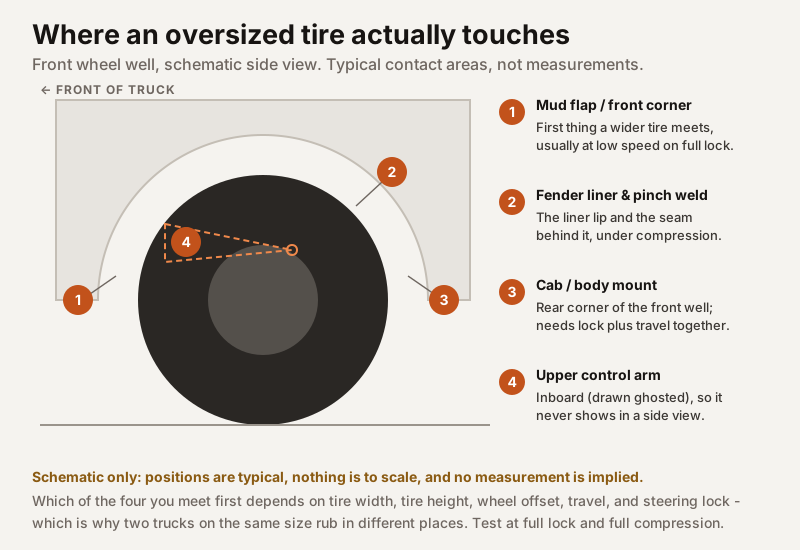
- Mud flaps - the first thing to hit and the easiest free fix; many owners just remove them.
- Fender liner - the plastic inner liner catches the wider tire at full lock.
- Pinch weld - the seam along the bottom lip of the fender, often rolled or trimmed.
- Cab mount (CMC) - the body bracket behind the front tire; the classic 2nd/3rd-gen barrier to 33s.
- Upper control arm - only a concern with tall lifts and long-travel setups, not stock suspension.
This is why a tire that looks like it clears in the driveway can still rub. Fitment has to be judged with the wheels turned fully and the suspension fully compressed - turning into a driveway, articulating over a rock, or hitting a dip with weight in the bed. On the Tacoma's independent front suspension the tire and fender move together in a straight line, so the tightest clearance shows up when you combine steering lock with compression, not when the truck sits parked and level.
Test it turned and loaded
Before committing, cycle the steering to full lock in both directions and load the truck or push over a driveway lip. A 285/70R17 that clears parked can still contact the liner or cab mount when you turn hard with weight in the bed. Owner reports vary for exactly this reason.
What are the cheapest fixes to make 33s fit?
You do not have to jump straight to a lift and a cab-mount chop. Several fixes cost little or nothing and are worth trying first, especially on a 3rd gen or if you run the narrow 255-width 33.
- Remove the front mud flaps - free, reversible, and often enough on its own for a mild 33 upsize.
- Keep stock-style positive offset - the high factory offset tucks the tire in and fits the widest 33 with the least cutting; do not add negative-offset wheels or spacers if fitment is your goal.
- Trim and roll the fender liner and pinch weld - a low-cost afternoon job that clears most of the remaining rub.
- Add a small level (about 1.5 to 2 inches up front) - it evens out the factory rake and buys a little room, but it is not a magic fitment fix on its own.
- Run the narrow 255/85R16 or 255/80R17 - a true 33 that sidesteps most width-related rubbing on 2nd/3rd-gen trucks.
A level is not the same as clearance
A leveling kit lifts the front to match the rear and adds a bit of room, but because the tire and fender move together on an independent front suspension, it does not by itself make a wide 33 clear at full compression. On 2nd/3rd-gen trucks the real clearance for a 285 still comes from trimming and keeping positive offset.
How is a 4th-gen Tacoma different from a 3rd gen for 33s?
The 4th-gen Tacoma (2024+) has a noticeably more forgiving front wheel opening than the 2nd and 3rd gens, and its base trims also run a much higher wheel offset (about +55 to +60 mm versus roughly +25 to +30 mm on a 3rd gen), which tucks the tire further in. Together those two things move the whole trimming ladder down a rung: a 285/70R17 that needs a liner trim and often a cab-mount chop on a 3rd gen is close to a bolt-on on a 4th gen. On the 4th gen, it is the 35s (315/70R17) that become the size demanding a lift and reversible crash-plate work.
Going up to a 33 also nudges a couple of drivetrain numbers on either generation. A 285/70R17 is about 3.5 percent taller than a stock 265/70R17, so it makes the speedometer read roughly 3.5 percent low (about 72.4 mph actual at an indicated 70) and acts like slightly taller gearing off the line. That is small enough that most owners leave it alone; regearing usually enters the conversation at 35s, though some 3rd-gen owners running heavy 33s and towing opt for a mild regear to about 4.56 or 4.88.
Confirm before you buy
Run your exact 33 through a tire calculator and a max tire size estimator for your generation, then verify it against your door-jamb placard, your wheel offset, and real owner photos of your trim. Two 285/70R17 tires from different brands can differ by half an inch, which is the difference between a bolt-on and a trim job.
Does a 4th-gen Tacoma come with 33s from the factory?
In Toyota's own words, yes - and that wording is worth reading carefully, because it is the clearest real-world example of everything this guide says about the '33' label. Toyota describes the 4th-gen off-road packages (TRD Pro, Trailhunter, and the i-FORCE MAX version of TRD Off-Road) as carrying a 33-inch tire on an 18-inch wheel. Our fitment dataset records that wording exactly as Toyota gives it, with no metric size attached, for the 2024 and 2025 model years - because the sources behind those rows state '33 in' and never state a metric equivalent, and inventing one would be putting a number in Toyota's mouth.
For 2026 the picture is sharper, because Toyota's current specifications do expose a trim-level metric size: Trailhunter, TRD Pro, and TRD Off-Road i-FORCE MAX are listed at 265/70R18. Run that through the same arithmetic as the rest of this page and it computes to 32.61 inches - the shortest tire on the 33 chart above, and 0.10 inches shorter than a 285/70R17. That is not Toyota exaggerating. It is the ordinary rounding this guide's second section describes, applied by the manufacturer: anything from roughly 32.6 to 33.1 inches gets marketed as a 33.
What a factory 33 tells you about fitting one
A factory 33 is the easiest 33 there is, because it comes with a wheel offset, a tire width, and a suspension the truck was engineered around. It is also the narrowest kind: at 10.43 inches, the 4th-gen factory 18-inch off-road tire is the same section width as a stock 265, not the 11.22 inches of a 285. If you want a 33 that behaves like the factory one, matching that width matters more than matching the height.
One practical consequence: on a 4th gen you can move to a genuine 33 without leaving factory geometry at all, by fitting the off-road trims' own size rather than the aftermarket 285. You keep the stock section width, you keep the tucked-in factory offset, and the only thing that changes is a full inch of diameter over a 265/70R17. Whether that is enough tire is a taste question - but it is the lowest-risk path to a 33 that exists on any Tacoma.
Which 33s can you actually buy for a Tacoma?
Fitment is only half the decision. A size that clears beautifully but is stocked by four tire models is a worse buy than a size with forty, because the second list contains the tire you actually want. Our tire research dataset scores 50 models against the Tacoma and records the sizes each one is offered in, so it can answer the availability question directly - and the answer varies enormously across the 33 family.
| Size | Models in the dataset | Category spread | What that means for buyers |
|---|---|---|---|
| 285/70R17 | 40 | 17 all-terrain, 11 rugged-terrain, 9 mud-terrain, 3 mild all-terrain | The deepest 33 catalog there is. Every category is represented. |
| 265/70R18 | 39 | 16 all-terrain, 11 rugged-terrain, 8 mild all-terrain, 4 highway | The only 33-class size with real highway and mild-A/T choice. |
| 285/75R16 | 29 | 11 all-terrain, 9 rugged-terrain, 9 mud-terrain | Strong catalog, but nothing tame - no highway or mild options. |
| 255/80R17 | 13 | 7 all-terrain, 4 mud-terrain, 2 rugged-terrain | Thin but usable, and the mainstream all-terrains are in it. |
| 33x12.50R17 | 12 | 9 mud-terrain, 3 rugged-terrain | Almost entirely aggressive tread. Pick this size for the look and the bite. |
| 255/85R16 | Not in the dataset | - | Our research set has no catalog entry for this size, so it cannot list models. That is a gap on our side, not evidence the size is unavailable. |
| 33x10.50R17 | Not in the dataset | - | Same gap: no catalog entry, so no model list. Cross-shop it against 255/80R17, which stands 0.06 in taller - 33.06 against a flat 33.00. |
Two patterns fall out of that table. First, the 285/70R17 is the default 33 for a reason that has nothing to do with clearance: it simply has the most tires in it. Second, the 265/70R18 is the only 33-class size where you can buy something quiet - it is the one that carries highway and mild all-terrain options, because it is a factory size on the 4th gen and tire makers build for factory sizes. Every other 33 on the list is an all-terrain-or-more proposition.
The same three all-terrains lead the ranked list in 285/70R17, 285/75R16, and 255/80R17, which makes cross-shopping easy: pick the size your truck clears, then pick from the same short list of models. In the wide flotation size the leaders are different because the tread choice is different - that size skews hard toward rugged- and mud-terrain.
- BFGoodrich All-Terrain T/A KO3 review
- Falken Wildpeak A/T4W review
- Toyo Open Country A/T III review
- Nitto Ridge Grappler review
- All 50 Tacoma tire reviews
How the scores behind those reviews are made
Every model score on this site is a 0-10 editorial synthesis of published reviews, manufacturer specifications, and retailer fitment data - not tires we tested ourselves. Availability counts are the sizes the dataset records each model as offered in, which is a research snapshot rather than live stock.
What does a jump to 33s actually cost, end to end?
The tires are rarely the whole bill. A 33 sets off a short chain of follow-on costs, and the chain is longer on a 2nd or 3rd gen than on a 4th gen. Working through it before you order is what stops a tire purchase turning into a six-week project. What follows is the chain itself, not a price list: this site does not track parts or labour prices, so it names what to budget for and leaves the numbers to your own quotes.
- The tires themselves, plus mounting, balancing, and disposal - and remember a fifth tire if you want the spare to match, which most people skip and then regret on a trail.
- Wheels, if your current offset works against you. Keeping stock-style positive offset is free and fits the widest 33 with the least cutting; buying lower-offset wheels for looks costs money and then costs trimming.
- Trimming. Mud-flap removal is free. Liner and pinch-weld work is a DIY afternoon, or shop time if you would rather not do it yourself. A cab-mount chop is a different order of job - permanent metalwork, and the real fork in the road.
- An alignment after any suspension change, and worth doing anyway once a taller tire changes the loaded ride height.
- A speedometer correction. A 285/70R17 reads about 3.5 percent low; a 255/80R17 or a 33x12.50R17 reads about 4.4 to 4.6 percent low. It is a tuner or programmer job, not a free one.
- Fuel and pace. A heavier, wider, more aggressive 33 costs a little MPG and a little throttle response on both generations - a real running cost rather than a one-off.
- TPMS sensors and a relearn if you are buying a second set of wheels rather than remounting on your own.
What is usually not on the list is a regear. At 33s the drivetrain penalty is small - a 285/70R17 behaves like about 3.4 percent taller gearing - and most owners live with it. A mild 4.56 is a nice-to-have on a bogged-down 3rd-gen V6 that tows; the 4th-gen 8-speed generally copes without one. Regearing means both axles and it is the single largest line on this list, which is why it is a 35-inch conversation far more often than a 33-inch one.
The cheapest 33 is the one your generation already likes
On a 4th gen, the cheapest route to a 33 is the factory off-road size on the factory offset: no trimming, no wheels, no lift. On a 2nd or 3rd gen it is the narrow 255-width 33 on stock wheels, which sidesteps most width-related rubbing. The expensive route on either truck is a wide 285 or a 12.5-inch flotation size on low-offset wheels - that combination is what turns a tire purchase into a trimming bill.
Frequently asked questions
On a 4th-gen Tacoma, a 285/70R17 (about 32.7 inches) is close to a bolt-on with at most mud-flap removal and minor liner or bumper-tab work. On a 2nd- or 3rd-gen Tacoma, 33s with no lift usually need removing the mud flaps, trimming the fender liner, and often a cab-mount chop, especially at full steering lock while loaded.
The common 33s are 285/70R17 (about 32.7 inches) on 17-inch wheels, 285/75R16 (about 32.8 inches) on 16s, and the narrow 255/85R16 (about 33 inches). A 255/80R17 is a narrow 33 on 17s. All round off to a 33 even though their measured diameters differ by a few tenths of an inch.
On a 2nd- or 3rd-gen Tacoma, often yes for a 285-width 33, especially with a lower-offset wheel or when turning hard while loaded - the cab mount is the body bracket the tire hits at full lock. A narrow 255-width 33 frequently avoids it. On a 4th-gen Tacoma the cab mount is not in the way for 33s.
Close to it. The 4th-gen wheel opening is more forgiving and base trims run a higher offset that tucks the tire in, so a 285/70R17 usually needs only mud-flap removal and minor liner or bumper-tab work - no cab-mount chop. Lower-offset wheels or spacers push the tire out and can require more trimming.
Yes. The 255/85R16 measures about 33 inches in overall diameter, so it is a true 33 - just a narrow one at about 10 inches wide instead of the 11.2 inches of a 285. That narrow width is why it fits with far less trimming, which is why many 2nd- and 3rd-gen owners choose it for stock 16-inch wheels.
A 285/70R17 is about 3.5 percent taller than a stock 265/70R17, so the speedometer reads roughly 3.5 percent low (about 72.4 mph actual at an indicated 70) and the odometer under-counts by the same amount. It is correctable with a tuner. A regear is not required for 33s; most owners save that for 35s, though some who tow choose a mild 4.56 or 4.88.
The tallest are 255/85R16 at 33.07 inches and 255/80R17 at 33.06 inches - and they are also the narrowest at 10.04 inches. The widest is 33x12.50R17 at 12.50 inches, which is 33.00 inches tall. Across the whole family, height varies by only 0.46 inches while width varies by 2.46 inches, so width is what decides how a 33 fits.
Toyota describes the 4th-gen TRD Pro, Trailhunter, and TRD Off-Road i-FORCE MAX packages as carrying a 33-inch tire on an 18-inch wheel. For 2026 the current specifications also give a metric size for those trims, 265/70R18, which computes to 32.61 inches - the normal industry rounding to a 33. For 2024 and 2025 the sources state only the 33-inch wording, so no metric equivalent should be attributed to Toyota for those years; confirm yours on the door placard.
285/70R17, with 40 of the 50 models in our Tacoma tire research dataset offered in it, spanning all-terrain, rugged-terrain, mud-terrain, and mild all-terrain. 265/70R18 is close behind at 39 models and is the only 33-class size with genuine highway and mild all-terrain options, because it is a factory size on the 4th gen. 285/75R16 has 29, 255/80R17 has 13, and 33x12.50R17 has 12, almost all of them aggressive treads.
They are the same 11.22 inches wide, because both start from a 285 mm section width, but the 285/75R16 is 32.83 inches tall against 32.71 for the 285/70R17 - a 0.12-inch difference from the taller sidewall on the smaller rim. Our modeled fitment ladder puts the 285/75R16 one rung higher on a 3rd gen for exactly that reason, which is a good illustration of how close these tier boundaries are.
Budget for mounting and balancing, possibly a fifth tire for a matching spare, liner and pinch-weld trimming (a DIY afternoon, or shop time if you would rather not), an alignment, and a speedometer correction. Wheels are optional but keeping stock-style positive offset is both free and the easiest path. A regear is the largest line of all and is usually a 35-inch decision rather than a 33-inch one. This site does not publish tire or parts prices - see our cost guide for why, and for a cost-per-mile method you feed your own quotes into.
Keep going
Sources
- Toyota Tacoma specifications (toyota.com)
- This site's Tacoma OEM trim fitment dataset (2017-2026), for the factory 33-inch package rows
- This site's generation clearance matrix and per-size candidate table, for the modeled fitment ladder
- This site's 50-model Tacoma tire research dataset, for the per-size availability counts
Compare your exact sizes
Run any size in this guide through the Tacoma tire calculator to see diameter, width, speedometer error, effective gearing, and highway RPM before you buy.