Max Tire Size by Tacoma Generation
Short answer
On a stock 2nd- or 3rd-gen Tacoma the biggest no-lift tire is about 31.6 inches (265/70R17); a 4th-gen clears near-33s close to bolt-on. A leveling kit and stock-style offset get you to a true 33 (285/70R17, about 32.7 in); 35s need a 3-inch lift, trimming or crash-bar removal, and usually a regear.
What is the biggest tire you can fit on a stock Tacoma with no lift?
The honest answer depends on your generation. On 2nd- and 3rd-gen trucks (2005-2023), the practical no-lift ceiling on stock-offset wheels is about 31.6 inches - a 265/70R17 or 265/75R16 - which tucks inside the fender cleanly. Push to a true 33 (285/70R17, about 32.7 inches) and those trucks start rubbing the fender liner and cab mount at full steering lock. The 4th-gen (2024+) is the outlier: its Tundra-derived body opening clears a near-33 almost bolt-on, so many owners run a 285/70R17 or the factory 265/70R18 close to bolt-on, with at most a reversible crash-bracket delete if a low-offset wheel or full-lock rub calls for it.
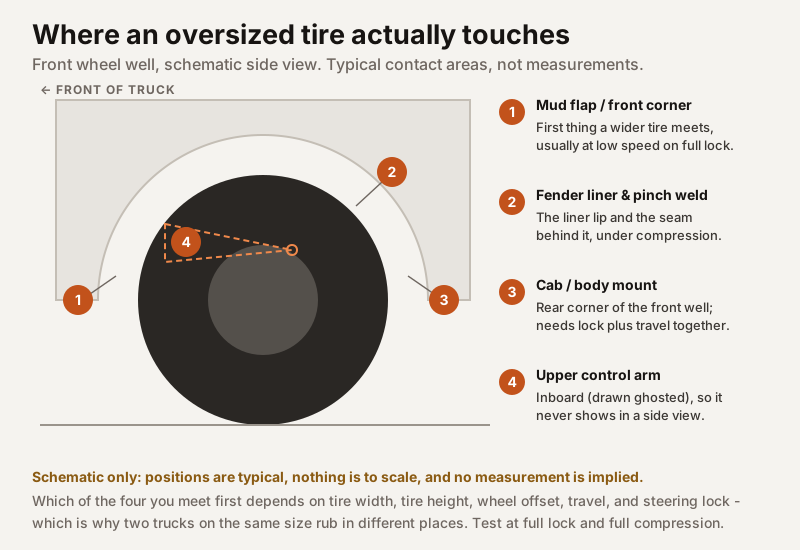
Three things set the ceiling, and all of them are about clearance, not just diameter. Knowing which one you hit first tells you what it costs to go bigger.
- The top of the fender liner and pinch weld - what a tall tire touches at ride height and over bumps.
- The rear inner corner of the wheel well (the cab or body mount) - what a wide tire touches at full lock, especially loaded.
- The frame and, on the 4th-gen, a bolt-on crash bracket - the last thing in the way once liner and mount are cleared.
The ceiling moves with your wheel offset
A lower or negative offset pushes the tire outboard and up into the liner, so a size that clears on a stock +55 mm 4th-gen wheel can rub on a -12 mm aftermarket wheel. Every size below assumes stock-style offset. Add poke and you move up the trimming ladder sooner.
Every generation and every lift tier, on one chart
Before the per-generation detail, here is the whole ladder in one picture. Each bar is the modeled ceiling diameter our clearance matrix estimates for that generation at that suspension tier, on stock-style offset. These are modeled estimates drawn through reviewed fitment ranges - not tires anyone here measured on a truck - and they are the conservative half of the answer, the half that tells you where the numbers stop rather than where owners get away with pushing them.
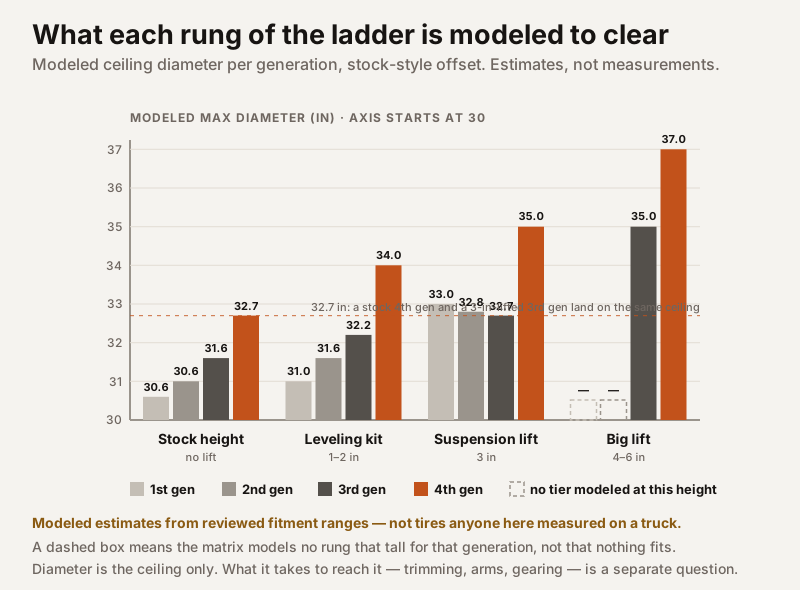
Three things stand out. First, the 4th gen does not just win at the top of the ladder - it wins at the bottom. Its stock-height ceiling of 32.7 inches is exactly the ceiling the matrix gives a 3rd gen on a full 3-inch suspension lift, and only 0.1 inches under the best a 3-inch-lifted 2nd gen is modeled to reach. Second, the tiers are not evenly spaced: on a 3rd gen the leveling kit and the 3-inch lift together add 1.1 inches, while the jump to a 4-6 inch lift adds another 2.3 inches on its own. Third, the total range a generation can cover widens with each redesign.
| Generation | Stock | Level adds | 3 in lift adds | 4-6 in lift adds | Stock to top |
|---|---|---|---|---|---|
| 1st gen (1995-2004) | 30.6 in | +0.4 in (31.0) | +2.0 in (33.0) | - | +2.4 in |
| 2nd gen (2005-2015) | 30.6 in | +1.0 in (31.6) | +1.2 in (32.8) | - | +2.2 in |
| 3rd gen (2016-2023) | 31.6 in | +0.6 in (32.2) | +0.5 in (32.7) | +2.3 in (35.0) | +3.4 in |
| 4th gen (2024-2026) | 32.7 in | +1.3 in (34.0) | +1.0 in (35.0) | +2.0 in (37.0) | +4.3 in |
Why the 3rd-gen middle rungs pay so badly
Going from stock to a 3-inch lift on a 3rd gen is modeled to buy 1.1 inches of tire - about the difference between a 265/70R17 and a 285/70R17. That is the honest reason the 3rd-gen 33 conversation is really a trimming conversation: on an independent front suspension, lift moves where the tire sits at rest, and only cutting moves where it stops at full compression. Owners routinely run 33s on leveled 3rd gens; they do it with a saw, not with ride height.
Read this chart as a ceiling, not a shopping list
A modeled ceiling says how tall a tire the generation is estimated to clear at that height. It says nothing about width, which is usually what actually rubs, and nothing about what the trip up the ladder costs in trimming, control arms, gearing, or alignment. The per-generation tables below carry those.
How big can you go on a 1st-gen Tacoma (1995-2004)?
The 1st gen is the smallest truck of the four and the one our data is thinnest on, so treat this section as the community-documented pattern rather than a sourced spec table - no Toyota document behind these rows sits in this repo, and our per-trim fitment dataset starts at 2017. Factory sizes ran small, from 195/75R14 up to 265/75R15 and the 31x10.5R15LT that came on some off-road packages, and the modeled stock ceiling is about 30.6 inches.
| Setup | Modeled ceiling | Approx diameter | What it takes |
|---|---|---|---|
| Stock, no lift | 265/75R15 | ~30.6 in | Bolt-on; the wells are tight, so stay near stock diameter |
| Leveling kit (~1-2 in) | 31x10.50R15 (31s) | ~31 in | Mud flaps off, fender-liner trim, and a pinch-weld roll is often needed |
| 3 in suspension lift | 33x10.50R15 (33s) | ~33 in | Pinch weld, liner trim, body-mount work; regear about 4.88 |
| Above that | Not modeled | - | Our matrix stops here for a 1st gen; builds that go bigger are fabrication projects, not fitment questions |
The one strong shape in the 1st-gen data is that tall and skinny clears where wide does not. The matrix's own ceiling at every tier is a narrow flotation size - a 10.50-inch-wide 31 or 33 rather than a 285-width metric - which is the same lesson the 255-width pizza cutter teaches on later trucks, just applied earlier and harder. A 1st gen that wants a 33 wants a 33x10.50R15, not a 285.
How big can you go on a 2nd-gen Tacoma (2005-2015)?
The 2nd-gen shipped on 245/75R16, 265/70R16, or 265/65R17 - all roughly 30.5 to 30.6 inches. Its wheel well is the tightest of the three generations, so a true 33 always means trimming. Stock offset runs around +30 mm, and the truck uses the 6x139.7 bolt pattern with a 106.1 mm hub bore and M12x1.5 studs, so most 3rd-gen and Tundra wheels bolt up. Most 2nd-gen builds top out at a 33; 35s are rare and rarely worth the fabrication.
| Setup | Biggest realistic tire | Approx diameter | What it takes |
|---|---|---|---|
| Stock, no lift | 265/70R17 or 265/75R16 | ~31.6 in | Bolt-on; may need mud flaps pulled at full lock |
| Leveling kit (~2 in) | 285/75R16 (a 33) | ~32.8 in | Fender-liner and pinch-weld trim, often a cab-mount chop; a level cures rake, not compression clearance |
| 3 in suspension lift | 33s (285/75R16 or 255/85R16) | ~32.8-33 in | Liner trim plus cab-mount chop; regear 4.56-4.88 to wake the truck back up |
| To run 35s | 35x12.50R17 / 315/70R17 | ~34.4-35 in | 3 in+ lift, welded cab-mount and body-mount chop, heavy fender trim, 4.88+ regear; uncommon on 2nd gen |
How big can you go on a 3rd-gen Tacoma (2016-2023)?
The 3rd-gen is the classic 33-inch platform, but a true 33 is not quite bolt-on. Stock sizes run 245/75R16 up to 265/70R17 (about 31.6 inches). Stock offset is roughly +25 to +30 mm; TRD Pro wheels sit lower at about +10 to +13 mm, which pokes the tire out and makes rubbing worse, not better. A 285/70R17 (about 32.7 inches) will contact the liner and cab mount at full lock on a stock truck, so plan on trimming, and often a cab-mount chop, before it clears cleanly.
| Setup | Biggest realistic tire | Approx diameter | What it takes |
|---|---|---|---|
| Stock, no lift | 265/70R17 (some run 275/70R17) | ~31.6-32.2 in | 265 is bolt-on; 275 usually needs mud-flap removal and light liner trim |
| Leveling kit (~1.5-2 in) | 285/70R17 (a true 33) | ~32.7 in | Fender-liner trim, often a cab-mount chop; a level removes rake but adds no compression clearance |
| 3 in suspension lift | 33s easily; up to 285/75R17 | ~32.7-34 in | Liner and pinch-weld trim; cab-mount chop common near 34; regear 4.56-4.88 |
| To run 35s | 35x12.50R17 / 315/70R17 | ~34.4-35 in | 3 in+ lift, welded cab-mount chop, fender trim, 4.88-5.29 regear front and rear |
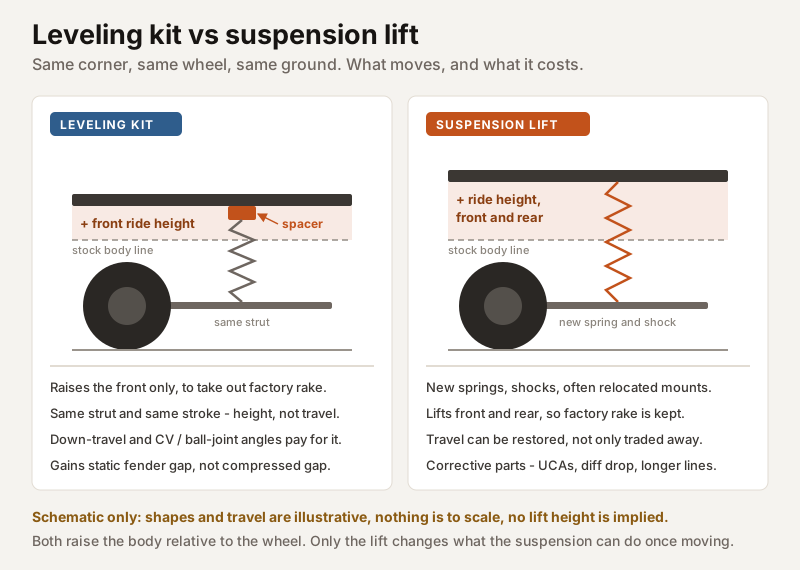
A leveling kit is not clearance
On the Tacoma's independent front suspension the tire and fender travel together, so a 1.5-2 in level mostly removes factory rake and restores down-travel. It helps stance and lets a slightly taller tire clear at ride height, but the rub you feel compressing over a bump comes back. Only trimming or a taller crash bracket adds real room at full compression.
How big can you go on a 4th-gen Tacoma (2024+)?
The 4th-gen shares its architecture with the Tundra, which pushes the cab mount rearward and opens the wheel well. That makes it the easiest Tacoma to fit big rubber: a near-33 is close to bolt-on, and 35s go on with a modest lift and a reversible bracket delete instead of the welding a 3rd-gen needs. Stock sizes run 245/70R17 (SR/SR5) up to 265/70R18 (TRD Pro, Trailhunter, about 32.6 inches). Base offset is high at roughly +55 to +60 mm, which tucks tires in; TRD Pro and Trailhunter sit lower at about +20 to +25 mm.
| Setup | Biggest realistic tire | Approx diameter | What it takes |
|---|---|---|---|
| Stock, no lift | 265/70R18 factory; near-33 (285/70R17 / 275/70R18) | ~32.6-33 in | 33s clear close to bolt-on on stock-style offset; high base offset helps tuck them in, and a reversible crash-bracket delete only if a low offset rubs at full lock |
| Leveling kit (~2 in) | 33s clean; 34s with minor trim | ~32.7-34 in | Level restores droop travel; minor liner or mud-flap trim for 34s |
| 3 in suspension lift | 35s (35x12.50) | ~34.4-35 in | Crash-bar/bracket removal (reversible, no cutting); a lower-offset wheel helps at lock |
| To run 35s | 35x12.50 on 17-18 in wheels | ~35 in | About a 3 in lift plus crash-bar removal, no frame cutting; regear optional on the 8AT, 4.88 for heavy use |
35s without permanent cutting
On the 4th-gen the front crash bracket bolts on (a few 17 mm bolts per side) and comes right off, so clearing 35s does not require the welded cab-mount chop a 3rd-gen needs. It is fully reversible. Still verify against owner photos on your exact trim, offset, and lift before buying.
What actually limits tire size - offset, trimming, and gearing?
Fitment is a ladder, not a single cut. As you go wider or taller (or run a lower offset), you work down this list, and most people stop as soon as the tire clears at full lock and full compression:
- Remove the mud flaps - the first and easiest gain.
- Trim the plastic fender liner and its metal tabs.
- Roll or trim the pinch weld along the fender lip.
- Cab-mount chop (CMC) - the big one on 2nd/3rd gen for 33s+; a bolt-on crash-bracket delete on the 4th gen.
- Body-mount chop (BMC) - only for the most aggressive 35-inch builds.
Gearing is the other cost that scales with size. Bigger tires are heavier and taller, which is like fitting a numerically lower (taller) axle ratio - the truck feels sluggish and downshifts more. Stock ratios are about 3.909 on the 3rd-gen V6 automatic (4.30 on the manual) and about 3.583 on the 4th-gen 8-speed. A 33 is usually livable, though a mild 4.56 wakes up a bogged-down 3rd-gen. Move to 35s and a regear becomes the sensible move.
When to regear (and what the job involves)
33s: optional - a 4.56 is a mild, nice-to-have on a 3rd-gen V6; the 4th-gen 8AT usually copes without one. 35s: regear front and rear, commonly to 4.88 (5.29 for heavy or manual trucks) - two gear sets plus the setup labour on both axles, and the largest single line in a 35-inch build. Whatever you fit, correct the speedometer - a taller tire makes it read low - and set LT tire pressure from a load table, not the door placard.
How much regear does each size on the ladder actually need?
The gearing conversation gets a lot easier once you separate two questions that sound the same. 'What ratio am I effectively running now?' is arithmetic: a taller tire divides your axle ratio by how much taller it is. 'What ratio should I buy?' is a judgement call, and it usually lands numerically higher than the arithmetic answer - on purpose.
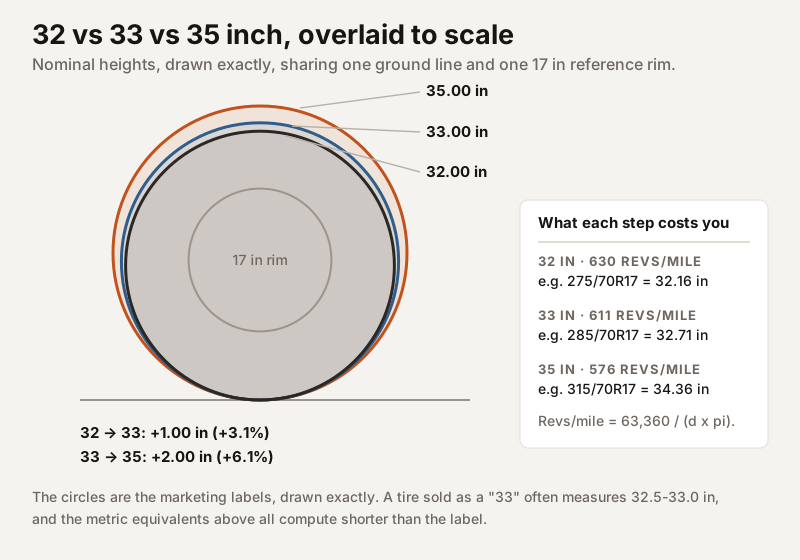
| Target size | Diameter | 3rd gen: effective ratio | 3rd gen: ratio to restore stock feel | 4th gen: effective ratio | 4th gen: ratio to restore stock feel |
|---|---|---|---|---|---|
| 285/70R17 (a 33) | 32.71 in | 3.78 (from 3.909) | 4.05 | 3.57 (from 3.583) | 3.59 |
| 33x12.50R17 | 33.00 in | 3.74 | 4.08 | 3.54 | 3.63 |
| 315/70R17 (a metric 35) | 34.36 in | 3.60 | 4.25 | 3.40 | 3.78 |
| 35x12.50R17 | 35.00 in | 3.53 | 4.33 | 3.34 | 3.85 |
| 37x12.50R17 | 37.00 in | 3.34 | 4.58 | 3.16 | 4.07 |
Now compare that to what people actually fit. Restoring the exact feel a 3rd gen had on its 31.6-inch factory tire takes about a 4.33 on 35s, yet the common recommendation - and the one our own matrix carries - is 4.88, sometimes 5.29. That is not a contradiction. Restoring stock gearing only gets you back to where a stock truck was, on a tire that is heavier, taller, and dragging more rotational inertia through every gear change. Builders aim past the restore number so the truck has more mechanical advantage than it started with, which is what you want when the extra tire came with extra weight, a bumper, and a rooftop tent.
- Up to a 33, the arithmetic says you lost roughly 3.5 to 4.5 percent of mechanical advantage on a 3rd gen, and well under 1.5 percent on a 4th gen that started from a 265/70R18. Most owners leave it alone.
- At a 33 with towing, a heavy LT tire, or a lot of stop-start hill work, a mild 4.56 on a 3rd gen sits comfortably between the restore number (about 4.08) and the full 4.88 build ratio.
- At 35s the restore number is about 4.33 on a 3rd gen; going to 4.88 buys back roughly another 13 percent on top of restoring stock, which is why it is the default for trail-focused builds.
- On a 4th gen the whole conversation shifts down, because the truck starts on a taller factory tire and a numerically lower 3.583 axle with an 8-speed to hide the gap. Its restore number for a 35 is only about 3.85.
- Whatever you pick, regear front and rear together. Mismatched ratios bind the drivetrain in four-wheel drive.
The arithmetic is the floor, not the answer
Use the restore column as a sanity check: if a shop quotes you a ratio numerically below it, the truck will be slower than stock on the new tire. Above it is a choice about how much you want back. Run your exact stock ratio and both diameters through a gear ratio calculator before you commit - the numbers here start from the common factory ratios, and yours may differ by trim, engine, and transmission.
How do I find my exact max tire size?
The tables above are the ceiling for a typical truck, but your exact answer comes down to your wheel offset, tire brand, alignment, and how hard you turn while loaded. Two 285/70R17 tires can differ half an inch in real width, and offset alone can flip a bolt-on into a trimming job. Before you buy, work through this short shopping list:
- Confirm your generation, trim, stock tire size, and wheel offset (check the door-jamb placard and the wheel spoke stamp, or look them up).
- Pick a target diameter, then run the specific tire model through a tire calculator to get its true diameter, width, and revs per mile.
- Feed your generation, lift, and offset into a max tire size estimator to see where you land on the trimming ladder.
- Cross-check against owner photos on your exact trim, wheel offset, and lift - the most reliable fitment proof there is.
- Budget for the extras a bigger size drives: trimming, a possible regear, a speedometer correction, and correct LT tire pressure.
Start with your factory numbers
If you are not sure of your stock size or offset, an OEM tire lookup pulls the factory fitment for your year and trim so the estimator and calculator start from the right baseline.
Frequently asked questions
On a stock 2nd- or 3rd-gen Tacoma, about 31.6 inches - a 265/70R17 or 265/75R16 - fits without trimming on stock-offset wheels. A stock 4th-gen is the exception: its more forgiving wheel opening clears a near-33 (285/70R17 or the factory 265/70R18) close to bolt-on, needing at most a reversible crash-bracket delete with a low-offset wheel.
Yes, but not cleanly bolt-on. A 285/70R17 (about 32.7 inches) rubs the fender liner and cab mount at full lock on a stock 3rd-gen, so plan on removing the mud flaps, trimming the liner, and often a cab-mount chop. A stock-style positive offset fits it with the least cutting; a lower TRD Pro-style offset makes rubbing worse.
Much easier. The 4th-gen shares the Tundra platform, which moves the cab mount back and opens the wheel well. Clearing 35s takes roughly a 3-inch lift plus removing a bolt-on front crash bracket - fully reversible, with no welding or frame cutting. A 3rd-gen, by contrast, needs a welded cab-mount chop for the same tire.
For 33s, a regear is optional - a mild 4.56 wakes up a sluggish 3rd-gen V6, while the 4th-gen 8-speed usually copes without one. For 35s, regearing front and rear is strongly recommended, commonly to 4.88 (5.29 for heavy or manual trucks). Price it as one job across two axles: two gear sets plus the precision setup labour, which is the larger half.
Only a little. On the Tacoma's independent front suspension the tire and fender move together, so a leveling kit mostly removes factory rake and restores down-travel rather than adding clearance at full compression. It helps stance and can let a slightly taller tire clear at ride height, but the rub over bumps comes back unless you also trim.
A marketed 35 is a 35x12.50 (about 35 inches) or, in metric, a 315/70R17 at roughly 34.4 inches. Both need a lift and clearance work on any Tacoma. On a 3rd-gen that means a welded cab-mount chop and usually a regear; on a 4th-gen, a reversible crash-bracket delete and, for heavy use, a regear.
Our matrix models about 30.6 inches at stock height, a 31 (31x10.50R15) on a leveling kit with mud flaps off and liner trim, and a 33 (33x10.50R15) on a 3-inch lift with pinch-weld, liner, and body-mount work plus about a 4.88 regear. No tier above that is modeled for this generation. Treat these as the community-documented pattern - no Toyota document for these years sits behind them.
Less than most people expect, and it varies by generation. Our modeled ceilings move by +0.4 inches on a 1st gen, +1.0 on a 2nd gen, +0.6 on a 3rd gen, and +1.3 on a 4th gen. On the Tacoma's independent front suspension a level changes where the tire sits at rest, not where it stops at full compression, so the extra tire usually still arrives with a trimming job attached.
On modeled tire ceiling, yes: both land at about 32.7 inches - a stock 4th gen and a 3rd gen on a 3-inch suspension lift. That says nothing about ground clearance, suspension travel, or approach angle, which the lift also changes and the factory ride height does not. It is a statement about how much tire the wheel well will take, and nothing more.
About 4.33 on a 3rd gen going from a 265/70R17 on a 3.909 axle, and about 3.85 on a 4th gen going from a 265/70R18 on a 3.583. Both are the arithmetic ratio that returns the mechanical advantage the taller tire took away. The common build recommendation of 4.88 deliberately aims past that, because a 35 also brings extra weight and rotational inertia that restoring stock gearing does not answer.
It changes the practical maximum, yes. Every ceiling on this page assumes stock-style positive offset, which tucks the tire inboard. A lower or negative offset, or a spacer, pushes the tire outward and up into the fender liner and the cab mount, so the same size that clears on a factory wheel can rub on an aggressive one. Poke costs you roughly a rung on the trimming ladder.
Keep going
Sources
- Toyota Tacoma specifications (toyota.com)
- Toyota Tacoma wheel and tire size reference (wheel-size.com)
- This site's generation clearance matrix, for every modeled ceiling on this page
- No Toyota document behind the 1st- and 2nd-generation rows: those spans predate this site's per-trim fitment dataset (2017-2026) and are the community-documented pattern
Compare your exact sizes
Run any size in this guide through the Tacoma tire calculator to see diameter, width, speedometer error, effective gearing, and highway RPM before you buy.