32 vs 33 Inch Tires on a Tacoma
Short answer
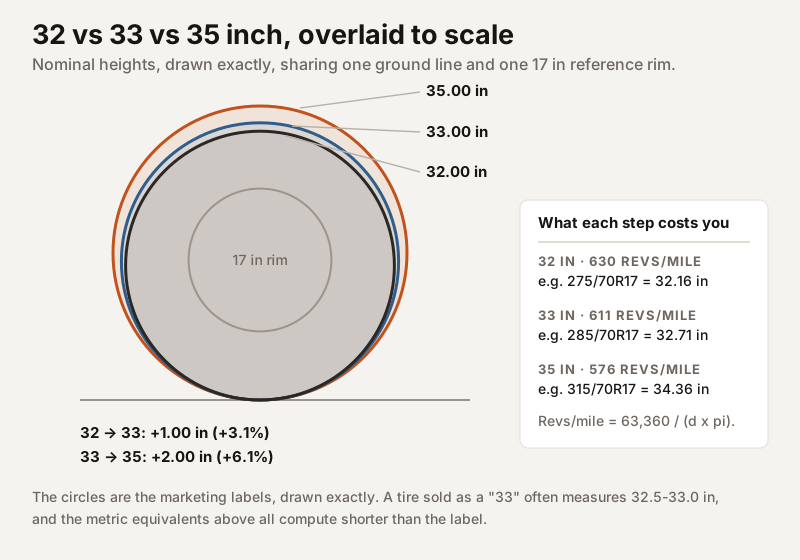
A 32-inch tire (about 275/70R17, roughly 32.2 in) and a 33-inch tire (about 285/70R17, roughly 32.7 in) differ by only about half an inch in height and 0.4 in in width. The 32 is a near-no-lift, low-drama bump; a true 33 usually needs trimming or a small level on a 3rd-gen Tacoma.
What is the real difference between a 32 and a 33 on a Tacoma?
In truck-tire shorthand, a 32 on a 17-inch Tacoma wheel almost always means a 275/70R17, and a 33 means a 285/70R17. Both keep the same 17-inch rim and the same 70-series aspect ratio, so the only spec that changes on the label is section width - 275 mm versus 285 mm. That 10 mm makes the tire about 0.4 inches wider and, because the sidewall is 70 percent of a slightly larger number, about 0.5 inches taller. Despite the 32-versus-33 naming, the two are separated by only about half an inch of diameter.
| Spec | 32 in (275/70R17) | 33 in (285/70R17) | Difference |
|---|---|---|---|
| Overall diameter | ~32.2 in | ~32.7 in | +~0.5 in taller |
| Section width | ~10.8 in (275 mm) | ~11.2 in (285 mm) | +~0.4 in wider |
| Sidewall height | ~7.6 in (192 mm) | ~7.85 in (200 mm) | +~0.25 in more sidewall |
| Revs per mile | ~627 | ~617 | ~10 fewer (about 1.7%) |
| Speedo vs stock 265/70R17 | reads ~1.8% low | reads ~3.5% low | 33 reads ~1.7% more low than the 32 |
| Clearance at the diff (half diameter) | baseline | +~0.25 in | small lift at the axle centerline |
| Typical tire weight | ~50-58 lb | ~50-60 lb | construction (P vs LT, load range) matters more than the size step |
32 and 33 are rounded marketing numbers
Neither size lands on its round number: a 275/70R17 measures about 32.2 in and a 285/70R17 about 32.7 in. Two 285s from different brands can also differ half an inch in real diameter and width. Run the specific model through a tire calculator before you buy.
How much does jumping from a 32 to a 33 change your speedometer?
A taller tire covers more ground per revolution, so the speedometer - which counts wheel turns - reads low. Measured against a common stock 265/70R17 (about 31.6 in), a 275/70R17 reads roughly 1.8 percent low and a 285/70R17 roughly 3.5 percent low. Between just the two sizes, the 33 reads about 1.7 percent more low than the 32: at an indicated 70 mph the 32 is about 71.2 mph actual and the 33 about 72.4 mph. Your odometer under-counts by the same percentage.
- 32 in (275/70R17): indicated 70 mph is about 71.2 mph actual; odometer logs roughly 982 miles per 1,000 driven.
- 33 in (285/70R17): indicated 70 mph is about 72.4 mph actual; odometer logs roughly 966 miles per 1,000 driven.
- If your stock tire is smaller than a 265/70R17 (for example a 245/70R17 at about 30.5 in), both errors grow - measure your current diameter before trusting these figures.
Either error is small enough that many owners leave it alone, but it matters for warranty mileage, resale, and speed-limited driving. On both 3rd- and 4th-gen trucks the reading can be recalibrated with a programmer or tuner; a speedometer correction calculator will give you the exact percentage to enter for your measured diameters.
Does a 32 or a 33 need trimming or a lift on a Tacoma?
This is where the two sizes stop being half an inch apart and become two different projects. On a 3rd-gen truck (2016-2023) with stock suspension and stock-offset wheels, a 275/70R17 is the classic near-no-lift size - many run it with just the mud flaps removed and maybe a minor fender-liner trim, and some clear it untrimmed on stock offset. A true 285/70R17 reliably needs more: liner trimming and frequently a cab-mount chop, or a small level to buy a little clearance up front. The 4th-gen truck (2024+) has a more forgiving wheel opening and handles both sizes with far less cutting.
| Generation | 32 in (275/70R17) | 33 in (285/70R17) |
|---|---|---|
| 3rd gen (2016-2023) | Near bolt-on; usually mud-flap removal, sometimes a minor liner trim | Rubs liner and cab mount at full lock; typically liner trim plus a cab-mount chop, or a small level |
| 4th gen (2024+) | Bolt-on, no trimming | Near bolt-on; the more forgiving opening usually needs only minor liner or bumper-tab work |
A level does not create clearance where a 33 rubs
A 1.5 to 2 inch leveling kit mostly removes the factory rake and helps the stance at ride height, but on Tacoma's IFS the tire and fender move together in compression - so a level does not add clearance at full stuff. Trimming, not lift, is what stops the rub. A lower- or negative-offset wheel also pushes the tire up into the liner sooner, turning a near-bolt-on into a trimming job.
How do 32s and 33s compare for weight, ride, and MPG?
The half-inch size step barely changes tire weight - construction dominates. As one example, a Falken Wildpeak AT3W in 275/70R17 runs about 57 lb, while the same tread in 285/70R17 is roughly 50 lb as a P-metric tire and closer to 59 lb as an LT 10-ply. In other words, whether you choose P versus LT and load range C, D, or E swings the weight and ride far more than 32 versus 33 does. Confirm the exact weight of the model you are considering.
- Load range C: lighter, softer sidewall, plenty of capacity for an unladen or lightly loaded Tacoma - usually the better daily ride.
- Load range E: much stiffer 10-ply-equivalent sidewall for heavy hauling and towing; rides harsher and can cost a little MPG if you never load the truck.
- Match or exceed the factory load index (Tacoma OE tires are load index 109 or higher), and set pressure from a load-inflation table rather than copying the door placard or running max sidewall (50 PSI for C, 65 for D, 80 for E).
Both sizes add a bit of rolling resistance and rotational mass versus a stock 265, and the 33 a touch more, so expect a small MPG drop and slightly softer acceleration and braking. On gearing, the taller tire acts like a numerically lower axle ratio: from a 3rd-gen 3.909, a 32 behaves like about 3.84 and a 33 like about 3.78. That difference is minor and neither size warrants a regear - that conversation usually starts at 35s, not 33s.
What do you actually gain off-road going from a 32 to a 33?
The upside of the 33 is real but modest: about a quarter inch more clearance under the diff, a slightly larger contact patch, and a bit more sidewall to air down for traction on rock and sand. The trade is a touch more road noise, marginally slower response, a small MPG hit, and - on a 3rd gen - the trimming needed to make it clear. For most trails the difference between a 275 and a 285 is smaller than the difference a good tire, correct pressure, and airing down make.
| Factor | 32 in (275/70R17) | 33 in (285/70R17) |
|---|---|---|
| Clearance at the axle | baseline | about 0.25 in more under the diff |
| Contact patch / air-down | less sidewall to flex | wider footprint and more sidewall aired down |
| Highway noise and ride | near-stock | slightly more hum, a touch softer |
| Acceleration and braking | near-stock | a hair slower - more rotating mass, taller gearing effect |
| Fuel economy | near-stock | small drop |
| Fitment work (3rd gen) | mud-flap removal, maybe minor liner trim | liner trim and often a cab-mount chop or small level |
Should you stop at a 32 or commit to a 33?
- Stop at a 32 (275/70R17) if you want the biggest tire that stays near-bolt-on on a 3rd gen, a near-stock ride and speedometer, best fuel economy, and little or no cutting - ideal for a daily-driven or lightly modified truck.
- Commit to a 33 (285/70R17) if you want the true 33-inch off-road stance and are comfortable with a mild speedo correction, a touch softer acceleration, and - on a 3rd gen - some liner and cab-mount work.
- On a 4th gen, both sizes are easy and a 285 is close to a bolt-on, so the choice is mostly about ride, economy, and stance rather than fitment.
- On a 3rd gen with stock wheels and no interest in cutting, the 275 is the safer buy; step up to a lower-offset wheel or add trimming and a small level before you commit to 285s.
Confirm before you commit
Measure your current tire, check your door-jamb placard and wheel offset, then run both sizes through a tire calculator and a max tire size estimator for your generation. Verify a 33 against real owner photos on your exact trim and wheel offset before buying.
Frequently asked questions
Effectively, yes. A 275/70R17 measures about 32.2 inches, which the industry rounds to a 32, and a 285/70R17 measures about 32.7 inches, rounded to a 33. Neither lands exactly on its round number, and different brands vary by up to half an inch, so measure the specific model rather than trusting the label.
Only about 0.5 inches taller (roughly 32.7 versus 32.2 inches) and about 0.4 inches wider (285 mm versus 275 mm section width), with about a quarter inch more sidewall. That half-inch step lifts the diff by about 0.25 inches. Despite the 32-versus-33 naming, the two sizes are closer than they sound.
Often, but not cleanly on a 3rd gen. A 285/70R17 on stock 3rd-gen suspension typically rubs the liner and cab mount at full lock, so most owners trim the liner and chop the cab mount rather than lift. A 4th-gen truck runs a 33 near bolt-on. A leveling kit does not add clearance in compression, so it is not a substitute for trimming.
Usually very little. On a 3rd gen, a 275/70R17 is one of the largest near-no-lift sizes - many owners just remove the mud flaps and, if anything, trim a small piece of the fender liner. On a 4th gen a 275 bolts on. Lower-offset wheels or hard turns while loaded can bring on light rubbing that a minor liner trim solves.
A little. The 33 is slightly wider and taller and is more often an LT-construction tire, which adds rolling resistance and rotating mass, so expect a small MPG drop and softer acceleration versus a 32. A load range C tire at the correct pressure minimizes the penalty; a heavy load range E tire widens it.
No. From a 3rd-gen 3.909 axle, a 32 acts like about 3.84 and a 33 like about 3.78 - a minor change that most drivers barely notice. Regearing usually enters the conversation at 35s, where the taller tire meaningfully saps low-end response. For 32s and 33s, a speedo recalibration is the only adjustment most owners make.
Keep going
Sources
Compare your exact sizes
Run any size in this guide through the Tacoma tire calculator to see diameter, width, speedometer error, effective gearing, and highway RPM before you buy.