Tacoma Tire Load Range, Ply Rating, and Weight Explained
Short answer
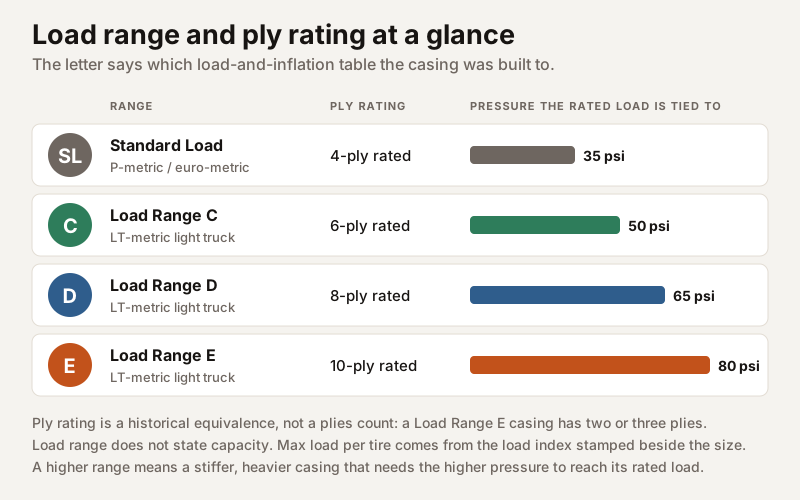
Toyota ships every Tacoma on standard-load (SL) P-metric tires with a load index of 109 or higher. Load range sets a tire's pressure ceiling and stiffness: C maxes at 50 PSI, D at 65, E at 80. E-rated (10-ply) tires add roughly 10-12 pounds per corner and ride firmer, so they mainly pay off for towing, armor, or sharp rock.
What load range does a Tacoma come with from the factory?
Every Tacoma leaves the factory on standard-load (SL) P-metric tires - the passenger-car construction tuned for ride comfort, quiet, and fuel economy. Toyota specs a minimum load index (109 or higher, which is at least 2,271 lb per tire) on the door-jamb placard, and any replacement should match or exceed it. Load range is not a size; it is a strength-and-pressure class layered on top of the size. The letter tells you the casing's maximum cold inflation and, roughly, how stiff and heavy the tire is.
| Load range | Ply-rating equivalent | Max cold PSI | Construction | Typical Tacoma use |
|---|---|---|---|---|
| SL (Standard Load) | 4-ply equivalent | ~44 | P-metric (passenger) | Factory replacement, daily driving, mild dirt roads |
| XL (Extra Load) | 4-ply reinforced | ~50 | P-metric reinforced | Heavier daily loads; uncommon in truck A/T sizes |
| C | 6-ply equivalent | 50 | LT (light truck) | Light overlanding, moderate trails, extra puncture resistance |
| D | 8-ply equivalent | 65 | LT (light truck) | Heavier hauling and towing, stiffer sidewall |
| E | 10-ply equivalent | 80 | LT (light truck) | Heavy towing, bed armor or camper, sharp rock, max load |
"10-ply" does not mean ten actual plies
Ply rating is a legacy strength label. A modern Load Range E tire typically has only two or three actual body plies but a casing built to the old 10-ply standard. So a tire can be a "10-ply" E-rated tire and still have far fewer physical layers than the name suggests.
What is the difference between P-metric (SL/XL) and LT (C/D/E) tires?
It comes down to casing construction. P-metric tires (a size that starts with P, or with no letter, such as 265/70R17) use a lighter passenger casing and only come in SL or the reinforced XL rating. LT (light-truck) tires - written LT265/70R17 - use a heavier, stronger casing and carry the C, D, or E load ranges, with higher maximum pressures and more puncture and load capacity. The tradeoff is weight and ride: the same tread pattern in an LT-E build is heavier and stiffer than its P-metric SL twin.
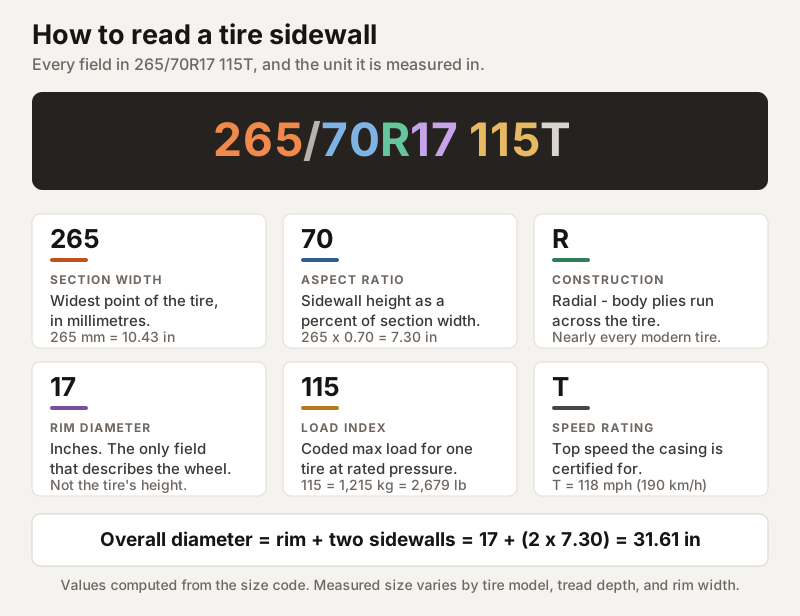
There is one catch buyers miss. When a P-metric passenger tire is fitted to a light truck like the Tacoma, its stamped load capacity is derated - you divide it by about 1.10, roughly a 10 percent reduction. A load-index-115 P-metric tire rated 2,679 lb on a car effectively provides about 2,436 lb on the Tacoma. That derate is already baked into how Toyota picked the factory size, but it matters if you are near your payload or tow rating and shopping P-metric versus LT.
- P-metric SL: lightest, softest, best ride and MPG; comes standard on the truck.
- P-metric XL: reinforced passenger casing, a little more capacity; rare in truck A/T sizes.
- LT-C: light-truck casing without the full weight of E; a popular middle ground.
- LT-D and LT-E: progressively heavier and stiffer, with 65 and 80 PSI ceilings for real load-carrying.
How much do all-terrain tires actually weigh?
More than most buyers expect, and load range is a big part of why. In a common 265/70R17 (about 31.6 inches), a standard-load Toyo Open Country A/T III weighs around 41 lb, while a Load Range E BFGoodrich KO2 or Falken Wildpeak A/T3W in the same size runs about 53 lb. That is roughly a 12 lb jump per corner - close to 50 lb across the truck - purely from the heavier casing, before you go up in diameter.
| Tire | Load range | Approx. weight (per tire) |
|---|---|---|
| Toyo Open Country A/T III | SL (P-metric) | ~41 lb |
| Falken Wildpeak A/T3W | SL (P-metric) | ~47 lb |
| Toyo Open Country A/T III | E (LT) | ~48 lb |
| BFGoodrich All-Terrain KO2 | E (LT) | ~53 lb |
| Falken Wildpeak A/T3W | E (LT) | ~53 lb |
Tire weight is unsprung and rotating mass - the worst kind to add. It is not supported by the springs, and it has to be spun up and stopped every time you accelerate or brake. Extra pounds at the wheel dull throttle response, lengthen stopping distances slightly, make the suspension work harder over bumps, and add steering effort. A wheel-and-tire package that is a few pounds lighter per corner is one of the cheapest ways to keep a lifted Tacoma feeling responsive.
Does an E-rated tire ride worse or hurt MPG?
Generally yes on both counts, though the size of the effect is modest. A stiffer LT-E casing transmits more of the road into the cabin, so ride quality is firmer and highway noise is usually a touch higher than an SL tire in the same tread. The added mass and rolling resistance shave a small amount off fuel economy and blunt acceleration. None of this is dramatic on its own, but it stacks: heavier, stiffer, thirstier, and a bit slower to stop and go.
Load range does not change your speedometer
Speedometer error comes from tire diameter, not load range. An SL and an E tire in the same size read the same speed. If you also go up in diameter, use the speedometer and MPG tools to see the correction and the fuel-economy hit from the taller, heavier tire.
When do you actually need E-load tires (and when is C or SL better)?
The honest answer for most Tacomas: you do not need E. The Tacoma is a mid-size truck, not a 3/4-ton, and its loads rarely demand a 10-ply casing. E-load earns its weight and ride penalty when you are consistently loading the truck heavily or abusing the sidewalls on rock. For pavement, mild dirt, and light trails, a standard-load or Load Range C tire rides better, weighs less, costs less, and returns better fuel economy while still handling the terrain.
- E is justified: towing near the truck's limit, a heavy camper or rooftop tent, steel bumpers and skid armor, bed drawers or a slide-in, or frequent sharp-rock and desert running aired down.
- C is a smart middle ground: overlanding and moderate trails where you want extra puncture resistance and sidewall protection without the full E weight.
- SL is best for the rest: daily driving, snow commuting, gravel roads, and light off-road, where ride, weight, and MPG matter more than casing strength.
- Match the load index on your door placard (109 or higher) whichever range you pick - a high load range does not excuse a low load index.
The E vs SL decision in one line
If the truck spends most of its life carrying or protecting itself against real abuse, buy E. If it spends most of its life commuting and doing light-to-moderate trails, buy SL or C and enjoy the lighter, softer, cheaper miles.
What tire pressure should I run for each load range?
Start with the door-jamb placard - roughly 30-35 PSI on a Tacoma - but remember it is calibrated to the factory P-metric size. A same-size LT tire generally needs a few more PSI than a P-metric to carry the same load, because the load tables differ. What you should not do is run an E tire at its 80 PSI sidewall maximum on an empty mid-size truck. That number is the casing ceiling for maximum rated load, not a target; on a light Tacoma it overinflates the tire, crowns the tread, wears the center, and makes the ride harsh.
Do not chase the sidewall max
The 50/65/80 PSI numbers for C/D/E are ceilings tied to maximum load. For an unloaded or lightly loaded Tacoma, the right pressure on an LT tire usually lands well below the max. Use a load-and-inflation table or a chalk test to find the pressure that flattens the contact patch, then confirm it with the pressure calculator.
Frequently asked questions
Every Tacoma ships on standard-load (SL) P-metric tires - passenger construction, not LT. Toyota specifies a minimum load index of 109 or higher (at least 2,271 lb per tire) on the door-jamb placard. There is no factory Tacoma trim that comes on Load Range C, D, or E tires; those are aftermarket upgrades owners choose for load or durability.
Usually no. A Tacoma is a mid-size truck, and standard-load or Load Range C tires that meet the placard load index handle most towing within the truck's rating. E-load makes sense if you routinely tow near the maximum, carry heavy bed armor or a camper, or want the stiffest sidewall for stability. For occasional light towing, the weight and ride penalty of E is not worth it.
Yes - SL is what the truck came with. As long as the replacement meets or exceeds the load index on your door placard (109 or higher), an SL tire is fully rated for the Tacoma. Just remember P-metric tires are derated about 10 percent when used on a light truck, so shop the load index carefully if you regularly run near your payload limit.
No. A higher load range adds casing strength and puncture resistance, but it also adds weight, stiffens the ride, raises rolling resistance, and costs more. If you are not loading or abusing the truck hard enough to use that strength, a lower range rides better and returns better fuel economy. Buy the load range your actual use demands, not the highest available.
Not 80. The 80 PSI E-rating is the sidewall ceiling for maximum load, not a target. Start near the door-jamb placard (about 30-35 PSI), then use a load-and-inflation table or a chalk test to find the pressure that flattens the contact patch. On a lightly loaded Tacoma that typically lands well below the sidewall max, often in the high 30s to mid 40s.
Ply rating is a legacy strength label, not a literal count. A Load Range C is a 6-ply-rated tire, D is 8-ply, and E is 10-ply, but modern tires reach those strengths with only two or three actual body plies plus stronger materials. So a 10-ply E-rated tire is built to the old 10-ply standard, not made of ten physical layers.
Keep going
Sources
Compare your exact sizes
Run any size in this guide through the Tacoma tire calculator to see diameter, width, speedometer error, effective gearing, and highway RPM before you buy.