Tacoma Tire Tread Depth: How to Measure It and When to Replace
Short answer
Tread depth is measured in 32nds of an inch. Wear bars sit at 2/32 in, which is also the pull point our cost-per-mile calculator projects down to. The penny and quarter tests are conventions, not instruments - a gauge is better. Worn tread shrinks diameter, so the calculators' assumptions move with it.
How is tire tread depth measured?
In thirty-seconds of an inch. It is an odd unit until you use it once: tread grooves are shallow, and 32nds give whole numbers where inches would give decimals. One 32nd is 0.03125 inches, so a tire reading 12/32 has 0.375 inches of rubber between the top of the tread block and the floor of the groove. Every US gauge, every shop inspection sheet, and our cost-per-mile calculator all speak in 32nds.
The measurement takes a minute and a cheap tool. Press the probe of a depth gauge to the floor of a major groove, shoulders flat on the tread blocks either side, and read the number. Take several readings rather than one: a tire run at the wrong pressure, or on a truck out of alignment, does not wear flat, and the average of a badly worn tire is a comfortable lie.
- Measure in the major grooves, not a sipe, a wear bar, or a stone ejector - those are shallower by design and read low.
- Take three readings across the tread on each tire: inside shoulder, center, outside shoulder. That spread is the diagnostic.
- Record the lowest number, not the average - a tire is as worn as its worn-out spot.
- Do all four and the spare - a full-size spare is often the deepest tire you own, and sometimes the oldest.
What our tire dataset does and does not hold
The 50-model tire set behind this site records category, snow rating, budget tier, candidate Tacoma sizes, and ten editorial 0-10 scores. It does not record tread depth. Any new-tread figure you see on this site is quoted on a head-to-head page for one specific size, from that manufacturer's own spec - not from a field we hold for every model.
What are wear bars, and do the penny and quarter tests work?
Your tires already have a depth gauge built in. Tread-wear indicator bars - wear bars - are raised ribs molded across the bottom of the main grooves at 2/32 of an inch. While tread remains they sit down in the groove; when the tread wears to their level they appear as smooth bands across the tire, and it is finished. Small triangles or the letters TWI on the shoulder point to where they live.
The coin tests are the folk versions of the same idea, worth knowing because they are the conventions people quote at each other. Both are approximations built on the height of a head on a US coin, and neither is a measuring instrument - a gauge costs a few dollars and gives you a number you can write down.
| Check | How it is done | What it signals | Precision |
|---|---|---|---|
| Wear bars (TWI) | Look into a main groove for a raised rib running across the tread | Flush with the tread means the tire is at 2/32 in and done | Molded into the tire at the pull point - the most reliable of the three |
| Penny test | Insert a penny into the groove with Lincoln's head upside down and facing you | If you can see the top of his head, the tread is at or near 2/32 in | Convention only; a coarse pass/fail at the very end of the tire's life |
| Quarter test | Same idea with a quarter, Washington's head upside down | Seeing the top of his head puts the tread near 4/32 in - the common 'start shopping' line | Convention only; useful as an earlier warning than the penny |
At what tread depth should you replace a Tacoma tire?
2/32 of an inch is the answer everyone converges on, and the number our own tools use: the cost-per-mile calculator projects a wear sample down to a 2/32 pull point because that is where usable life ends. It is also commonly cited as the legal minimum across most US states, though the rule is written state by state - treat your own statute and inspection station as the authority.
The more useful framing is that 2/32 is where you must stop, not where you should. Water evacuation, snow packing, and mud clearing all depend on groove volume, and wear is what takes groove volume away. The bands below are conventional shop guidance for that reason - judgement calls about risk, not thresholds anyone can prove for your roads.
| Remaining depth | What has changed | Common guidance |
|---|---|---|
| New (as molded) | Full groove volume, full water and snow capacity | Baseline - record it, because a tread-life projection needs the starting number |
| About 6/32 in | Snow and slush capacity is meaningfully down; deep-snow bite fades before wet grip does | Commonly cited as the point to plan a winter-tire replacement |
| About 4/32 in | Wet grip and hydroplaning resistance are noticeably reduced | The common 'start shopping' line, and the quarter test's threshold |
| 2/32 in or below | Wear bars are flush with the tread; groove volume is gone | Replace. This is the pull point, the wear-bar depth, and the usual legal floor |
Depth is not the only reason to replace a tire
A tire with plenty of tread can still be finished. Sidewall cuts, bulges, or impact damage, an unrepairable shoulder or sidewall puncture, cracking from age and UV, or wear so uneven that one shoulder is at the bars while the center is deep - each retires a tire whatever the gauge says. Uneven wear in particular is a message about alignment, pressure, or missed rotations, and replacing the tire without fixing the cause buys the same problem again.
Do all-terrains start deeper than highway tires?
As a broad industry pattern, yes - aggressive off-road patterns generally carry more rubber and deeper voids than highway patterns, because clearing mud is what the depth is for. But there is no table of starting depths by category on this page, because our dataset does not carry that field. Depth varies by model, size, and sometimes load range, and a per-category figure would be exactly the kind of number this site exists not to publish.
What the dataset does hold is a tread-life score: an editorial 0-10 judgement, one of ten axes we assign to each of the 50 models, meaning expected mileage before replacement. It is synthesis from published specs, manufacturer positioning, and owner-reported experience - never our own testing, and never a depth measurement. Averaged by category it shows the shape of the trade-off clearly.
| Category | Models in set | Mean tread-life score |
|---|---|---|
| Highway all-season | 4 | 9.0 |
| Mild all-terrain | 8 | 8.1 |
| All-terrain | 18 | 7.7 |
| Rugged-terrain hybrid | 11 | 7.0 |
| Mud-terrain | 9 | 5.0 |
How does worn tread change what the calculators tell you?
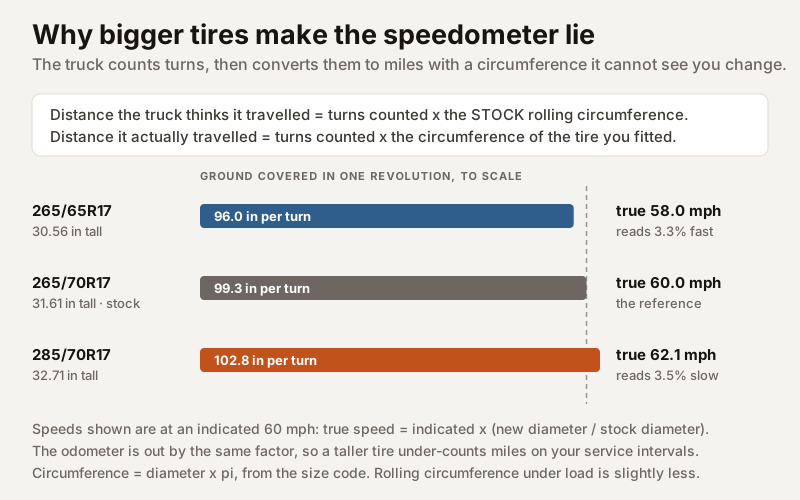
This is the part almost nobody accounts for. Every size calculation on this site starts from the same identity: overall diameter equals rim diameter plus two sidewalls. Tread sits at the outer surface of each sidewall, so wearing rubber off the tread takes it off both the top and the bottom of the tire. Lose 10/32 of an inch of depth and the tire loses twice that - 0.625 inches - from its overall diameter.
| Tread worn off each side | Overall diameter | Change from new | Revs per mile |
|---|---|---|---|
| 0 (as calculated new) | 31.61 in | - | 638 |
| 4/32 in | 31.36 in | -0.25 in (-0.8%) | 643 |
| 6/32 in | 31.23 in | -0.38 in (-1.2%) | 646 |
| 8/32 in | 31.11 in | -0.50 in (-1.6%) | 648 |
| 10/32 in | 30.98 in | -0.63 in (-2.0%) | 651 |
Two percent is small next to a size change, but it always runs the same direction. A smaller tire covers less ground per revolution, so a speedometer calibrated for the new size reads slightly fast as tread goes - an indicated 70 mph is closer to 68.6 mph on a fully worn set. The odometer over-counts by the same fraction, inflating the mileage denominator in a cost-per-mile calculation.
What actually makes a set of tires last?
Nothing exotic, and nothing you buy. Pressure, rotation, and alignment are the three levers, all cheap next to a set of light-truck tires. Get them right and the wear pattern stays flat, so the whole tread surface reaches the pull point together instead of one shoulder retiring a tire with 6/32 left everywhere else.
- Pressure, set cold to the door placard. Underinflation wears both shoulders and overinflation wears the center - the wear pattern itself tells you which mistake you are making.
- Rotation on a regular interval, so the front tires' steering wear and the rear tires' driven wear get shared out across all four.
- Alignment whenever the truck has been lifted, leveled, or has taken a hard hit. One shoulder wearing alone is an alignment message, and no amount of rotation fixes it.
- Load discipline and driving style, which are the free ones. Heat, hard cornering, and hard braking on a heavy truck all cash out in 32nds.
Frequently asked questions
2/32 of an inch is the figure cited almost everywhere in the United States, and it is the depth the molded wear bars sit at - a tire whose wear bars are flush with the tread is done. The exact rule is written state by state, so confirm your own state's statute. Our cost-per-mile calculator projects tread life down to that same pull point.
It works as the rough go/no-go check it is meant to be. Put a penny in a main groove with Lincoln's head upside down; if you can see the top of his head, the tread is at or near 2/32 of an inch. It is a convention built on coin dimensions, not an instrument, and it only speaks to the very end of the tire's life. A gauge costs a few dollars and gives you a usable number.
It varies by model, by size, and sometimes by load range within one model, and our 50-model dataset does not record tread depth, so we will not publish a per-category figure. As an industry pattern, aggressive off-road tread is generally deeper than highway tread. Check the manufacturer's spec sheet for your exact size, and write the number down.
Slightly, and always in the same direction. Tread sits on the outside of the tire, so wearing 10/32 of an inch off the tread takes twice that - 0.63 inches - out of overall diameter. On a 265/70R17 that is about 2 percent, so an indicated 70 mph is closer to 68.6 mph on a fully worn set, and the odometer over-counts by the same fraction.
Matching tread depth across an axle is the practical minimum, and matching all four is the safer habit on a four-wheel-drive truck, because differing rolling diameters mean the wheels turn at different speeds - the same problem a mismatched spare creates. If you replace only two, the deeper pair conventionally goes on the rear.
Keep going
Sources
- Taco Tires tread-life model - the 2/32 in pull point and the 32nds wear-rate projection held in this repo and used by the cost-per-mile calculator
- Taco Tires tire dataset - 50 Tacoma-relevant models with category, snow rating, budget tier and ten editorial 0-10 scores. The tread-life scores quoted here are that editorial synthesis, not testing; the dataset carries no tread-depth field
- Taco Tires size math - diameter = rim + 2 sidewalls and revs per mile = 63,360 / circumference, the same functions the tire calculator uses
- Your state's tread-depth statute, your vehicle's door placard, and your tire manufacturer's spec sheet - the authorities for the legal minimum, pressure, and the tire's own as-molded depth
Compare your exact sizes
Run any size in this guide through the Tacoma tire calculator to see diameter, width, speedometer error, effective gearing, and highway RPM before you buy.