Tacoma Wheel Offset and Backspacing Explained
Short answer
Stock Tacoma wheel offset runs about +25 to +30 mm on 3rd-gen trucks and +55 to +60 mm on most 4th-gen trims (TRD Pro and Trailhunter sit lower). Backspacing equals wheel width divided by 2, plus 0.5, plus offset in inches. Lowering offset pushes the tire outward 1:1; keep spacers at or under 1.25 inches.
What is wheel offset, and how is it different from backspacing?
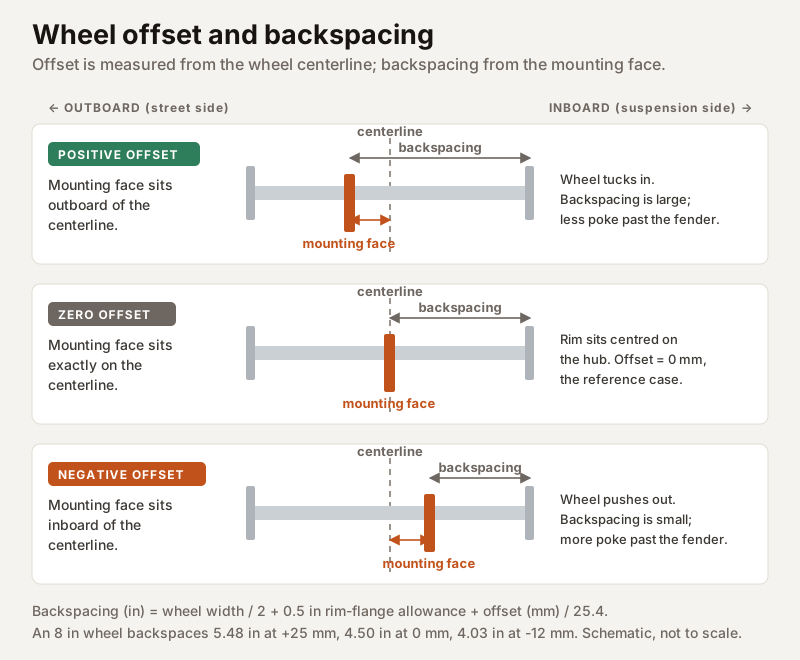
Offset is the distance, in millimeters, between the wheel's mounting face (where it bolts to the hub) and the true centerline of the wheel. A positive offset means the mounting face sits outboard of centerline, which tucks the wheel and tire in toward the truck. A negative offset means the mounting face sits inboard, which pushes the wheel out and gives you 'poke.' Nearly all factory Tacoma wheels use a fairly high positive offset.
Backspacing measures the same idea from the other direction: it is the distance, in inches, from the mounting face to the inboard lip of the wheel. Offset and backspacing describe one physical position, so if you know one plus the wheel width, you can calculate the other. Wheel shops usually spec offset; fabricators and off-roaders often think in backspacing because it tells you how close the tire sits to the suspension and frame.
Quick definitions
Offset = mm from centerline to the hub face (higher = tucked in). Backspacing = inches from the hub face to the inner lip (more backspacing = tucked in). Poke = how far the tire sticks out past the fender, which grows as offset drops.
What is the stock wheel offset on a Tacoma?
Stock offset varies a lot by generation and trim, and that matters because it sets your baseline: a 4th-gen base truck starts with a much higher offset (tire tucked deep) than a 3rd-gen TRD Pro. The numbers below are approximate and shift slightly by model year and wheel option, so confirm your specific wheel's stamped offset before buying tires or spacers.
| Generation / trim | Typical stock offset | What it means |
|---|---|---|
| 3rd gen (2016-2023), most trims | +25 to +30 mm | Tire tucked well inside the fender; forgiving for upsizing. |
| 3rd gen TRD Pro | +10 to +13 mm | Lower factory offset for a wider stance and a bit more poke. |
| 4th gen (2024+), SR / SR5 / TRD Sport / Limited | +55 to +60 mm | Deep backspacing; the tire sits far inboard from the box. |
| 4th gen TRD Pro / Trailhunter | +20 to +25 mm | Factory low-offset look with noticeably more poke than base trims. |
The practical takeaway: a 4th-gen base wheel at roughly +55 to +60 mm has a huge amount of room to come outward before it pokes, while a 3rd-gen truck near +30 mm is already fairly close to a flush look. Whatever your starting point, dropping offset moves the tire outward at a predictable rate covered in the next section.
How do you calculate backspacing from offset?
The conversion uses the wheel's marked width, not its true width. A wheel's overall width is about one inch more than the size stamped on it, because the tire bead flanges add roughly half an inch on each side. That is where the +0.5 in the formula comes from.
The backspacing formula
backspacing (in) = wheel width / 2 + 0.5 + offset (mm) / 25.4. Example: a 17x9 wheel at 0 mm offset = 9 / 2 + 0.5 + 0 = 5.0 in of backspacing. The same 17x9 at +18 mm = 4.5 + 0.5 + 0.71 = about 5.71 in, which pulls the tire roughly 0.7 in farther inboard.
The single most useful rule is that offset changes move the tire outward 1:1. Because 25.4 mm equals one inch, every 25 mm you drop offset pushes the tire and the outer wheel lip almost exactly one inch farther out (about 0.98 in). So going from a stock 3rd-gen +30 mm to 0 mm moves the tire out roughly 1.18 in; going from a 4th-gen +60 mm down to +10 mm moves it out about 2 in. That outward movement is what creates stance, and also what eventually causes rubbing.
One caution when comparing wheels: two wheels can have similar backspacing but very different poke if their widths differ. A wider wheel with the same offset adds width on both sides, so a chunk of the extra width sticks outward. Always compare width and offset together, and picture where the outer lip ends up relative to your fender.
What offset should you run on a Tacoma?
There is no single right answer; it is a trade between look and clearance. Keeping the factory offset fits the biggest tire with the least rubbing, while a lower offset looks more aggressive but moves you up the trimming ladder and adds stress to the front end. Many Tacoma enthusiasts settle around 0 mm as a balance of stance and function.
| Goal | Target wheel offset | Typical result |
|---|---|---|
| Keep it stock, fit the biggest tire | Factory offset | Tire tucked in, least rubbing, easiest fitment. |
| Mild wider stance, subtle look | About +12 to +18 mm | A little poke; minimal rub risk on stock-diameter tires. |
| Aggressive stance, wider tires | About 0 to +10 mm | Enthusiast favorite; watch fender-liner rub at full lock. |
| Maximum poke | Negative (below 0 mm) | Rubbing, road spray, and extra bearing load; not ideal for a daily driver. |
Lower offset moves you up the trimming ladder
A lower-offset wheel pushes a given tire outward and up into the fender liner sooner. A tire size that bolts on at stock offset can require mud-flap removal, liner trimming, or a cab-mount chop once you drop to 0 mm or negative. Test any new setup at full steering lock and full compression.
How do wheel spacers change offset and backspacing?
A wheel spacer is simply a negative-offset change made with a plate instead of a different wheel. A spacer of a given thickness reduces your effective offset by that same thickness and moves the tire outward the same amount. A 1.25-inch spacer equals 31.75 mm, so bolting one behind a 4th-gen +60 mm wheel makes it behave like roughly a +28 mm wheel - close to a stock 3rd-gen stance - while keeping the same wheels and tires.
- Effective offset = wheel offset minus spacer thickness. A 25 mm spacer on a +30 mm wheel behaves like +5 mm.
- Keep spacers at or under 1.25 inches. Thicker spacers extend the load arm on the wheel bearing and studs and are harder to run safely.
- Use hub-centric, bolt-on spacers that carry their own studs, then torque and re-torque the lug nuts after the first drive.
- Match the hub bore: 4th-gen hubs are 95.1 mm and 3rd-gen and earlier are 106.1 mm, so the spacer must center on the correct hub.
Spacer vs. low-offset wheel
For tire position and bearing load, a 1.25-inch spacer and a wheel with 31.75 mm less offset are essentially the same. Choose whichever gets you the stance and clearance you want, and stay within the 1.25-inch guideline either way.
What happens if the offset is too low or negative?
Pushing the tire far outboard is not free. Beyond the obvious rubbing at the fender liner, mud flaps, and pinch weld, a very low or negative offset increases the scrub radius and the leverage on the front hub. That can mean heavier steering, more tramlining and bump steer, more road spray and rock chips, and added load on the wheel bearings, which can shorten their life over time.
- Rubbing at full lock and full compression, often needing liner or cab-mount trimming.
- Higher steering effort and more sensitivity to ruts and grooves in the road.
- Extra wheel-bearing and hub stress from the longer load arm - the same reason to cap spacers at 1.25 inches.
- Tire sticking out past the fender, which some regions restrict for coverage or mud-flap laws.
Remember that offset and backspacing only matter once the wheel physically bolts up. Both 3rd- and 4th-gen Tacomas share a 6x139.7 mm bolt pattern, but the hub bore differs (106.1 mm on 3rd gen and earlier versus 95.1 mm on 4th gen), so a wheel or spacer meant for one generation may need a hub-centric ring on the other. Confirm bolt pattern, hub bore, and load rating first, then dial in offset for stance and clearance.
Frequently asked questions
Most 3rd-gen Tacomas (2016-2023) run about +25 to +30 mm, with the 3rd-gen TRD Pro lower at roughly +10 to +13 mm. Most 4th-gen base and mid trims run a much higher +55 to +60 mm, while the 4th-gen TRD Pro and Trailhunter sit around +20 to +25 mm. Confirm the number stamped on your specific wheel.
They describe the same wheel position, so neither is more correct - they are just measured differently. Offset (mm from centerline) is what tire shops list and what governs poke. Backspacing (inches from the hub face to the inner lip) tells fabricators how close the tire sits to the suspension and frame. Convert between them with wheel width and the backspacing formula.
Almost exactly 1:1. Because 25.4 mm equals one inch, every 25 mm you drop the offset moves the tire and outer wheel lip about one inch farther outboard. Going from a stock 3rd-gen +30 mm to 0 mm pokes the tire out roughly 1.18 inches, which is enough to change fitment and start rubbing on some setups.
A 1.25-inch spacer equals 31.75 mm and reduces your effective offset by that amount, moving the tire outward about 1.25 inches. On a 4th-gen +60 mm wheel it produces roughly a +28 mm effective offset. Keep spacers at or under 1.25 inches, use hub-centric bolt-on units, and re-torque the lugs after your first drive.
You can, and it creates an aggressive stance, but it comes with trade-offs: more rubbing at full lock, heavier steering from the larger scrub radius, more road spray, and added wheel-bearing load. Many owners target around 0 mm as a balance instead. If you go negative, plan on trimming and verify clearance turned and loaded.
No. Offset and backspacing set how far in or out the wheel sits; they do not change the bolt pattern, which is 6x139.7 mm on both 3rd- and 4th-gen Tacomas. You do need to match hub bore, though - 106.1 mm on 3rd gen and earlier versus 95.1 mm on 4th gen - so a cross-generation wheel may need a hub-centric ring.
Keep going
Sources
Compare your exact sizes
Run any size in this guide through the Tacoma tire calculator to see diameter, width, speedometer error, effective gearing, and highway RPM before you buy.