Tire Size vs Wheel Size: How to Read a Tacoma Tire
Short answer
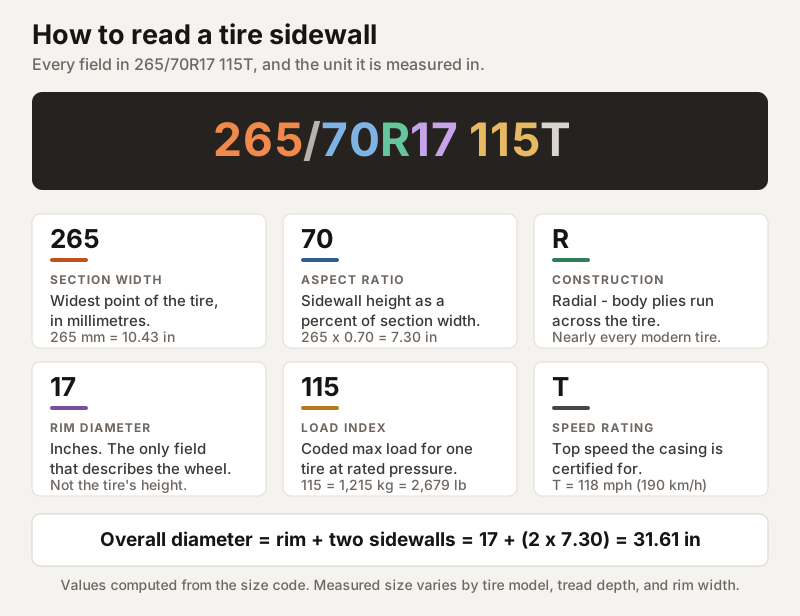
In a size like 265/70R17, 265 is the section width in millimeters, 70 is the aspect ratio (sidewall height as a percent of width, here about 7.3 inches), R means radial, and 17 is the wheel diameter in inches. Rim size is not tire height - overall diameter is the rim plus two sidewalls, about 31.6 inches here.
What do the numbers in a tire size like 265/70R17 mean?
A tire size is four pieces of information packed into one code. Reading 265/70R17 left to right: 265 is the section width, 70 is the aspect ratio, R is the construction type, and 17 is the diameter of the wheel it mounts to. Only that last number describes the wheel - everything before it describes the tire.
| Code | Name | What it tells you |
|---|---|---|
| 265 | Section width | The tire is 265 mm (about 10.4 in) wide at the widest point of the sidewall, measured on a specified rim width. |
| 70 | Aspect ratio | Sidewall height is 70% of the width: 265 x 0.70 = 185.5 mm, about 7.3 in from bead to tread. |
| R | Construction | Radial - the body plies run radially across the tire. Nearly every modern passenger and light-truck tire is a radial. |
| 17 | Rim diameter | Mounts on a 17-inch wheel. This is the only number in the size that refers to the wheel. |
An optional load index and speed rating often follow the diameter, such as 265/70R17 115T, where the number is the load index and the letter is the speed rating. Light-truck tires add an LT prefix (for example LT285/70R17) and a load range letter - C, D, or E - that sets the maximum cold pressure. Tacoma original-equipment tires carry a load index of 109 or higher.
Is the rim size the same as the tire's height?
No. The rim diameter is only one of three inputs into how tall the tire actually stands. Overall diameter in inches equals the rim diameter plus two sidewalls: rim + 2 x (section width mm x aspect / 100) / 25.4. For 265/70R17 that is 17 + 2 x 7.3 = about 31.6 inches. Change the width or the aspect ratio and the height changes even though the wheel does not.
This is why two tires on the same 17-inch wheel can be very different heights. A 245/70R17 stands about 30.5 inches tall, while a 285/75R17 stands about 34 inches - a 3.5-inch difference on an identical wheel. The wheel size tells you what the tire bolts to, not how big the tire is.
Wheel size sets the hole, not the height
Think of the rim number as the diameter of the hole in the center of the tire. The tire's real height is that number plus twice the sidewall. Two sidewalls of rubber can add 12 to 17 inches on top of the rim.
How can a 17-inch wheel run a taller tire than an 18-inch wheel?
Because the sidewall does the work. Overall height is the rim plus two sidewalls, so a smaller wheel simply leaves more room for sidewall at the same total diameter. Hold overall diameter at about 31.6 inches and drop the rim size, and the sidewall grows to fill the gap. That extra rubber is exactly what off-road builds want.
| Tire size | Rim | Aspect ratio | Sidewall height | Overall diameter |
|---|---|---|---|---|
| 265/75R16 | 16 in | 75 | ~7.8 in | ~31.6 in |
| 265/70R17 | 17 in | 70 | ~7.3 in | ~31.6 in |
| 265/65R18 | 18 in | 65 | ~6.8 in | ~31.6 in |
| 265/55R20 | 20 in | 55 | ~5.7 in | ~31.5 in |
Now pick tall sidewalls on a small wheel and short sidewalls on a big wheel and the smaller wheel wins outright on height. A 285/75R17 stands about 34 inches; a 275/55R18 stands only about 30 inches. The 17-inch setup is roughly four inches taller than the 18-inch one, even though its wheel is an inch smaller - all because of the sidewall.
What is the difference between metric and flotation tire sizes?
You will see two labeling systems on Tacoma tires. Metric (P-metric or LT) sizes like 265/70R17 give width in millimeters, sidewall as a percentage, and rim in inches. Flotation, or high-flotation, sizes like 33x12.50R17 give the overall diameter in inches, the section width in inches, and the rim in inches. Flotation sizing is common on aggressive all-terrain and mud-terrain tires.
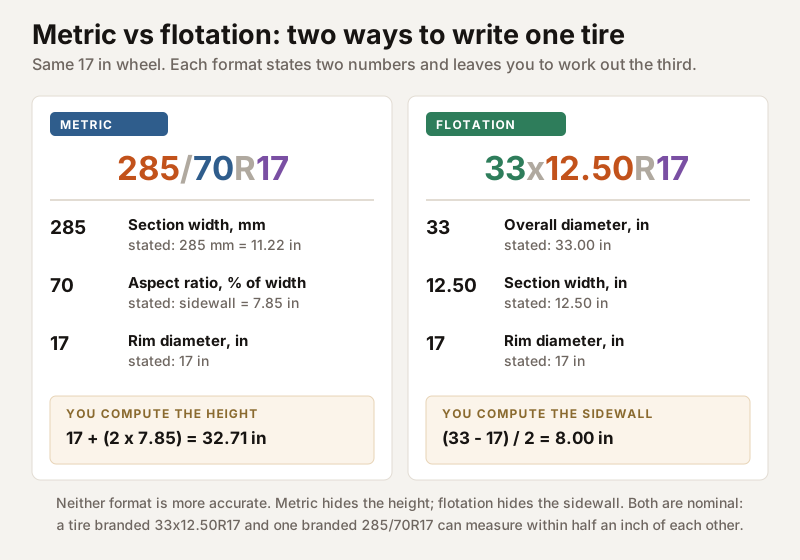
- Metric: 265/70R17 - width 265 mm, sidewall 70% of width, 17-inch rim. The first number is width, not height.
- Flotation: 33x12.50R17 - about 33 inches tall, about 12.50 inches wide, 17-inch rim. The first number is height.
- Flotation numbers are nominal and rounded: a labeled 33 often measures closer to 32.5 inches, and the stated width applies at a specific rim width.
Rough metric-to-flotation match
A 285/70R17 (about 32.7 in tall, 11.2 in wide) is the metric near-equivalent of a 33-inch flotation tire, and a 315/70R17 is essentially a 35x12.50R17 (about 34 to 35 in). When comparing across systems, compare measured overall diameters, not the labels.
How does wheel size change ride, air-down, and rim protection?
At a fixed overall diameter, a smaller wheel means more sidewall and a larger wheel means less. More sidewall flexes more, which softens the ride, airs down better for traction off-road, and shields the wheel lip from rocks and curbs. Less sidewall sharpens on-road steering response but exposes the rim and rides firmer. This is why 17-inch wheels are the popular Tacoma off-road choice and 18s or 20s lean toward street use.
| Rim size | Sidewall | On-road feel | Off-road air-down and rim protection |
|---|---|---|---|
| 16 in | ~7.8 in | Softest; can feel slightly vague at speed | Most sidewall flex; best air-down and rim protection |
| 17 in | ~7.3 in | Balanced; the popular off-road pick | Great air-down and rim protection, widest tire selection |
| 18 in | ~6.8 in | Crisper steering; many street tire options | Less sidewall for air-down; rims more exposed on trail |
| 20 in | ~5.7 in | Sharpest on-road, harshest over bumps | Little sidewall; poor air-down, rims most exposed |
How do I read my own Tacoma's tire size?
Your factory size is printed two places: the tire information placard on the driver's door jamb, and the sidewall of the tire itself. The placard also lists the recommended cold pressure. Current Tacomas ship in several sizes by trim - 245/70R17 on SR and SR5, 265/65R18 on TRD Sport and Limited, 265/70R17 on TRD PreRunner and Off-Road, and 265/70R18 on TRD Pro and Trailhunter - so confirm your own rather than assuming.
Turn the numbers into inches
Drop your size into a tire-size-to-inches converter to see overall diameter, width, and sidewall, then use a plus-size calculator to compare a new size against stock before you buy. Keeping overall diameter close to stock keeps your speedometer, gearing, and ABS behavior accurate.
Frequently asked questions
265 is the section width in millimeters (about 10.4 inches across). 70 is the aspect ratio, meaning the sidewall is 70% of the width, or about 7.3 inches tall. R stands for radial construction. 17 is the wheel diameter in inches. Together they work out to an overall tire height of roughly 31.6 inches.
Not necessarily. Wheel diameter is only one part of overall tire height, which is the rim plus two sidewalls. A 17-inch wheel with a tall sidewall (285/75R17, about 34 inches) stands taller than an 18-inch wheel with a short sidewall (275/55R18, about 30 inches). The tire's height depends on all three numbers, not just the rim.
That is flotation sizing, common on off-road tires. It reads as about 33 inches tall, about 12.50 inches wide, on a 17-inch rim - so the first number is height, not width. Flotation labels are rounded, so a 33 often measures closer to 32.5 inches. The metric near-equivalent is roughly a 285/70R17.
For off-road use, 17-inch wheels are the popular choice: at the same tire height they leave more sidewall, which airs down better, absorbs impacts, and protects the rim, plus the tire selection is huge. 18-inch wheels feel a touch crisper on pavement and offer more street tire options but give up sidewall for trail use.
Only if the width and rim stay the same. Aspect ratio is the sidewall as a percentage of width, so 265/65R18 has a shorter sidewall than 265/70R17. But because the 18 has a bigger rim, both end up near 31.6 inches overall. Aspect ratio alone does not tell you total height - you need all three numbers.
Keep going
Sources
Compare your exact sizes
Run any size in this guide through the Tacoma tire calculator to see diameter, width, speedometer error, effective gearing, and highway RPM before you buy.