Load Range E vs SL Tires on a Tacoma: Which Do You Need?
Short answer
Most Tacomas do not need Load Range E tires. A standard-load (SL) or load range C tire rides softer, weighs a few pounds less per corner, and helps MPG - plenty for a daily-driven or lightly loaded truck. Save E for heavy towing, a camper, steel armor, or sharp-rock trails. Many 33-35 inch tires only come in E.
Do you actually need E-rated tires on a Tacoma?
For most Tacomas, no. A Tacoma is a mid-size truck with a payload and towing rating far below a 3/4-ton, and it leaves the factory on P-metric standard-load (SL) tires - not Load Range E. Unless you regularly load the truck heavily or expose the sidewalls to real abuse, a Load Range E tire mostly adds weight and stiffness you paid for but never use. SL or load range C rides better, weighs less, and helps fuel economy while still carrying everything a Tacoma is rated for.
The rule of thumb
Go SL or C for a daily driver, mild overlander, or light-duty truck. Step up to Load Range E only if you tow near capacity, carry a heavy camper or bed load, run steel bumpers and skid plates, or wheel sharp rock where cuts and pinch flats are a real risk. Everything in between is a judgment call - lean lighter unless a specific need pushes you up.
What is the difference between SL, C, and E load ranges?
Load range describes how much air pressure a tire is built to hold and, by extension, how much load it can carry and how stiff its sidewall is. SL (standard load) is a passenger-tire construction, roughly a 4-ply equivalent. Load ranges C, D, and E are light-truck (LT) constructions with progressively more plies and higher maximum pressures - about 6-ply, 8-ply, and 10-ply equivalents. More plies means a stiffer, tougher, heavier carcass. Load Range D sits between C and E; it is less common on Tacoma-sized tires but follows the same pattern.
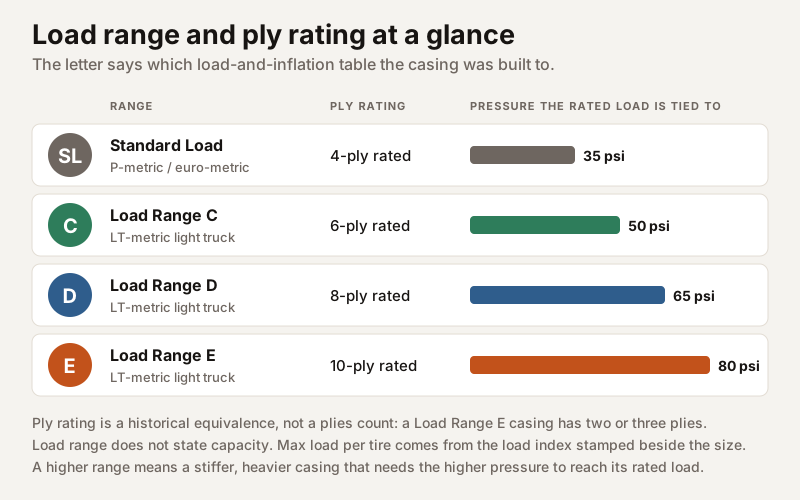
| Load range | Ply rating (equiv.) | Max cold PSI | Sidewall / cut resistance | Weight, 285 A/T | Unladen ride | When it is justified |
|---|---|---|---|---|---|---|
| SL (Standard Load) | ~4-ply | ~35-44 psi | Softest - least cut and pinch resistance | ~48-52 lb | Smoothest, most compliant | Daily driving, pavement, dirt roads, lightly loaded trucks |
| C | ~6-ply | ~50 psi | Moderate - noticeably tougher than SL | ~52-56 lb | Firmer but livable | Light towing, most overlanding, mixed trails |
| E | ~10-ply | ~80 psi | Stiffest - best cut, puncture, and pinch-flat resistance | ~55-60 lb | Firmest - can feel harsh empty | Heavy towing, campers, steel armor, sharp rock |
Load range is not the same as load index
Load range (SL/C/E) tells you the sidewall construction; the load index (a number like 109 or 116) tells you the actual pounds each tire can carry. Tacoma OE tires are load index 109 or higher, so match or beat that number no matter which load range you choose. Many SL and C tires already meet or exceed the factory index without going all the way to E.
How does load range change ride, weight, and MPG?
The stiffer carcass that makes an E tire tough is the same thing that makes it ride harshly when the bed is empty. On an unladen Tacoma, a Load Range E tire transmits more of every expansion joint and pothole into the cab, and it takes more weight to get moving and stopping. Compared with an SL version of the same size, an E tire typically adds roughly 5 to 10 pounds per corner - unsprung, rotating weight that a truck feels more than static cargo weight.
- Ride: SL is softest, C is firmer but still comfortable, E is the harshest when the truck is empty. Airing down helps, but you cannot fully tune away the stiffer carcass.
- Weight: expect roughly 5-10 lb more per tire going from SL to E in the same size - about 20-40 lb of rotating mass across four tires.
- MPG: heavier, stiffer tires with more rolling resistance usually cost a small amount of fuel economy. The penalty is modest but real, and it stacks with any diameter or tread change.
- Acceleration and braking: extra rotating mass dulls both slightly - most noticeable on a four-cylinder or a loaded truck on grades.
When is Load Range E actually worth it on a Tacoma?
Load Range E earns its weight when the tire is either carrying heavy load or taking real sidewall abuse. The extra plies give you higher load capacity at pressure, a firmer footprint under a heavy tongue weight, and far better resistance to cuts and pinch flats on sharp rock. If your use case includes any of the following, E (or at least C/D) is the sensible choice.
- You tow near the truck's rated limit or carry a slide-in or bed camper for extended trips.
- You run a heavy build - steel front and rear bumpers, a winch, skid plates, drawers, water, and gear that lives in the truck.
- You wheel sharp, rocky terrain where sidewall cuts and pinch flats are a genuine risk and a trail flat is a serious problem.
- You air down hard and often; a stiffer sidewall is more forgiving of low pressures over rocks.
Do not confuse toughness with your only defense
A Load Range E tire resists cuts better, but no load range makes a tire cut-proof, and E does nothing extra for tread wear or traction on its own. If you rarely load the truck and stick to dirt roads and mild trails, you are buying stiffness and weight you will not use - and a harsher daily ride to go with it.
Does tire size force you into Load Range E?
Sometimes, yes - and this is where the choice is often made for you. Once you move into aggressive 33- and 35-inch sizes, the catalog thins out. Many popular off-road sizes such as LT285/75R17, 255/85R16, and the 35x12.50R17 class are sold primarily or exclusively in LT constructions, and those LT versions are frequently offered only in load range D or E. Even where an SL or C option exists on paper, it may not come in the tread pattern or brand you want.
So if you have your heart set on a specific big tire, check availability before you commit to a load range. On a 265/70R17 or 275/70R17 you usually have SL, C, and E to choose from; on a true 35 you may find that E is the only construction offered, which quietly settles the ride-versus-toughness debate. When the size only exists in E, plan on the firmer ride and set pressure carefully to claw some of it back.
What pressure should you run, and how do you decide?
Pressure matters more with LT tires than most owners realize. Your door-jamb placard (about 30-35 psi) is calibrated for the soft P-metric OE tire, and the max sidewall pressure (50 psi for C, 65 for D, 80 for E) is only for maximum rated load. Running an unladen Tacoma at an E tire's 80 psi max is a common reason people complain that E tires ride like a wheelbarrow. Set pressure from a load-inflation table for your measured axle weights instead.
A realistic LT starting point
On a lightly loaded Tacoma, many owners land somewhere around 35-45 psi front and rear on LT C or E tires - well below max sidewall. Weigh each axle, look up the pressure that supports that load for your tire, then adjust for comfort and even wear (check the chalk test or a wear pattern). Never just copy the placard or run max sidewall.
- Daily driver, light gear, dirt roads: SL, at or near placard pressure. Softest ride, lightest, best MPG.
- Overlander with moderate weight or light towing: load range C, aired to match your loaded weight. The best all-around balance for most builds.
- Heavy towing, camper, steel armor, or sharp-rock wheeling: load range E, pressure set from a load-inflation table - not the placard, not 80 psi.
- Whatever you pick, meet or beat the factory load index (109+) and confirm the size and pressure against your specific tire's spec sheet.
Frequently asked questions
Most owners do not. A Tacoma is a mid-size truck that ships on P-metric standard-load tires, and SL or load range C carries everything it is rated for while riding softer, weighing less, and helping MPG. Choose Load Range E only if you tow near capacity, run a heavy camper or armor, or wheel sharp rock where sidewall cuts are a real risk.
Usually, yes. On an empty or lightly loaded Tacoma, an E tire's 10-ply-equivalent sidewall rides harshly over bumps and adds several pounds of rotating weight per corner without giving you capacity you use. For pavement, dirt roads, and mild trails, an SL or load range C tire is more comfortable, lighter, and slightly better on fuel while still meeting the truck's load rating.
Typically a little. E tires are heavier and stiffer with more rolling resistance than an SL version of the same size, so most owners see a small MPG drop. The penalty is modest on its own but stacks with any increase in tire diameter or a more aggressive tread. Correct inflation and a lighter load range minimize it.
Not the door placard and not the 80 psi max sidewall. Use a load-inflation table for your measured axle weights; on a lightly loaded Tacoma that often lands around 35-45 psi front and rear. Weigh the truck, find the pressure that supports that load for your tire, then fine-tune for ride and even wear.
No, but the bigger and more aggressive you go, the fewer lighter options exist. Many 33s are available in SL or C, while a lot of true 35s and hardcore mud-terrains are sold only in LT load range D or E. Check availability for your exact size and tread before assuming you can get a softer construction.
For light to moderate towing, load range C is often plenty and rides better than E. As long as the tire's load index meets or beats the factory 109-plus rating and you set pressure for the loaded weight, C handles typical Tacoma trailer duty. Reserve E for towing near the truck's rated limit or carrying a heavy camper.
Keep going
Sources
Compare your exact sizes
Run any size in this guide through the Tacoma tire calculator to see diameter, width, speedometer error, effective gearing, and highway RPM before you buy.