#1 Highway7/10
Michelin Defender LTX M/S2
Best for quiet daily, wet roads, long treadlife.
- On-road
- 10/10
- Trail
- 3/10
- Snow
- 5/10
- Treadlife
- 10/10
Short answer
The best Tacoma tire depends on how you drive. For mostly-pavement trucks, a highway tire like the Michelin Defender LTX M/S2 is quietest and longest-wearing. For the do-everything Tacoma, an all-terrain such as the Falken Wildpeak A/T4W or BFGoodrich KO2/KO3 is the sweet spot, and 16 of the 18 all-terrains here carry the 3PMSF winter rating across the full line. Only step up to a rugged- or mud-terrain if you regularly run rocks and deep mud — no mud-terrain in this dataset carries 3PMSF across its full line, and the one partial exception, the Mickey Thompson Baja Boss M/T, is rated in select sizes only.
Pick the category that matches how you actually use your Tacoma, then choose a top pick from that group below. The “top pick” column is the dataset's own top-ranked model in each category, which is not always the highest-scoring one - rank weighs how well a tire suits a Tacoma specifically, and the blended score on each card is a flat average across the axes.
| Category | Best for | Top pick |
|---|---|---|
| Highway / All-Season | Daily driving, commuting, towing on pavement | Michelin Defender LTX M/S2 |
| Mild All-Terrain | Mostly street with occasional dirt and gravel | Firestone Destination A/T2 |
| All-Terrain | Overlanding, dirt roads, light snow, and daily driving | BFGoodrich All-Terrain T/A KO3 |
| Rugged-Terrain (Hybrid) | Rocky trails and mud with street manners | Nitto Ridge Grappler |
| Mud-Terrain | Serious mud, rock crawling, and deep off-road | BFGoodrich Mud-Terrain T/A KM3 |
Scores here are an editorial synthesis of published manufacturer specifications, tire-industry write-ups, retailer fitment data, and Tacoma-owner reports — Taco Tires runs no instrumented testing of its own. How we score tires.
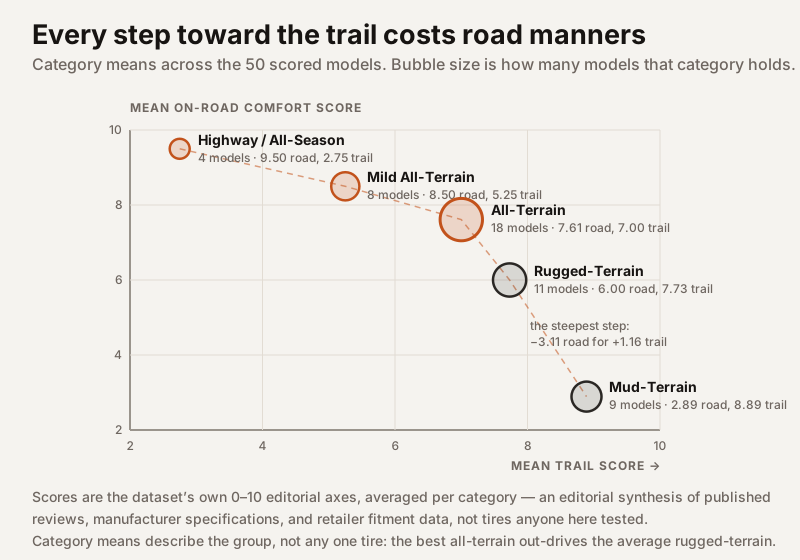
Every step toward the trail is paid for on the road, and the exchange rate is not constant. Averaging the 50 scored models by category shows a single downward curve: as mean trail capability rises, mean on-road comfort falls - gently at first, then off a cliff at the last step.
| Category | Models | Mean on-road | Mean trail | Mean treadlife | 3PMSF winter rated |
|---|---|---|---|---|---|
| Highway / All-Season | 4 | 9.50 | 2.75 | 9.00 | 0 of 4 |
| Mild All-Terrain | 8 | 8.50 | 5.25 | 8.13 | 5 of 8 |
| All-Terrain | 18 | 7.61 | 7.00 | 7.67 | 16 of 18 |
| Rugged-Terrain (Hybrid) | 11 | 6.00 | 7.73 | 7.00 | 6 of 11 |
| Mud-Terrain | 9 | 2.89 | 8.89 | 5.00 | 0 of 9 |
The winter column counts FULL-LINE 3PMSF ratings. One model, the Mickey Thompson Baja Boss M/T, is 3PMSF in select sizes rather than across the line, so it is not counted here.
Three readings matter for a buyer. Moving from a highway tire to a mild all-terrain buys 2.50 points of mean trail for 1.00 point of mean comfort - the best exchange rate on the whole curve, which is why a mild all-terrain is the safe default for a Tacoma that sees gravel a few times a year. Moving from all-terrain to rugged-terrain costs 1.61 points of comfort for 0.73 of trail, so it is a look-and-toughness decision as much as a capability one. And the last step, rugged- to mud-terrain, costs 3.11 points of comfort for 1.16 of trail: the worst trade on the board, and the right one only if deep mud and rock are genuinely routine for you.
The winter column is the one most people miss. 27 of the 50 models carry the three-peak mountain snowflake rating across the full line, and they concentrate in the middle of the curve: 16 of 18 all-terrains have it, while no highway tire and no mud-terrain does. The one partial exception is the Mickey Thompson Baja Boss M/T, a mud-terrain that is 3PMSF in select sizes rather than across the line. If snow matters, the aggressive end of the range is a downgrade, not an upgrade.
Category advice assumes you want a balance. Plenty of buyers do not - they want the quietest tire, or the one that lasts longest, or the one that will not let them down in February. Here is the highest scorer on each of the ten axes the dataset scores, with the runner-up beside it, so a single-priority buyer can go straight to the answer.
| If you want | Highest scorer | Score | Runner-up |
|---|---|---|---|
| Quietest on pavement | Michelin Defender LTX M/S2 | 10/10 | Continental TerrainContact H/T |
| Best in the wet | Michelin Defender LTX M/S2 | 9/10 | Continental TerrainContact A/T |
| Best in snow | BFGoodrich All-Terrain T/A KO3 | 9/10 | Falken Wildpeak A/T4W |
| Best on the trail | BFGoodrich All-Terrain T/A KO3 | 9/10 | BFGoodrich All-Terrain T/A KO2 |
| Best in mud | BFGoodrich Mud-Terrain T/A KM3 | 10/10 | Toyo Open Country M/T |
| Toughest casing | BFGoodrich Mud-Terrain T/A KM3 | 10/10 | Toyo Open Country M/T |
| Longest treadlife | Michelin Defender LTX M/S2 | 10/10 | Toyo Open Country A/T III |
| Kindest to MPG | Michelin Defender LTX M/S2 | 9/10 | Continental TerrainContact H/T |
| Most aggressive look | Nitto Ridge Grappler | 10/10 | BFGoodrich Mud-Terrain T/A KM3 |
| Best value | Kumho Road Venture AT52 | 9/10 | Sumitomo Encounter AT2 |
Read the table as a whole and the shape of the dataset appears. One highway tire leads four separate axes - comfort, wet grip, treadlife, and efficiency - which is a fair summary of what a highway tire is for. The trail, mud, durability, and appearance axes are led by tires you would not want to commute on. And nothing leads both halves, which is the entire reason this page is organised by use case rather than by an overall winner.
Two of those rows deserve a caveat. Ties are common because the axes are scored in whole points, so several models sit level at the top and the order shown breaks the tie by the dataset's own rank rather than by anything measured. And a high score on one axis says nothing about the rest - the model leading mud is near the bottom of the dataset on road comfort. Follow the link to its review page before you buy on a single number.
The dataset tags 3 of 50 models as a low budget tier, and they are worth knowing by name because a cheap tire that scores well is rarer than a good expensive one:
Note the categories that list does not reach. The low-budget tier in this dataset is concentrated in all-terrain and rugged-terrain tread, with no highway, mild all-terrain, or mud-terrain entry - convenient if an all-terrain is what you wanted, and a reason to shop the medium tier if it is not.
Each spoke ranks its whole category rather than the three cards this hub shows, and explains what separates the models inside it. Use this page to choose the category and the spoke to choose the model.
All 50 scored models have a dedicated page with the full ten-axis score breakdown, the Tacoma sizes the dataset records the model as offered in, who it suits and who it does not, and the sources behind its scores. If a name on this page looks like a candidate, that page is where to check it properly before spending money.
The quietest ride with the best treadlife and fuel economy — ideal for Tacomas that live mostly on pavement.
Best for quiet daily, wet roads, long treadlife.
Best for quiet daily, wet roads, long treadlife.
Best for quiet daily, wet roads, long treadlife.
Light-duty all-terrains that stay quiet and efficient on-road while handling gravel, dirt, and light snow.
Best for quiet daily, light trail, snow.
Best for daily all weather, quiet daily, light trail.
Best for quiet daily, wet roads, light trail.
The do-everything Tacoma tire: dependable in dirt, gravel, and snow while staying civil on the highway.
Best for balanced all terrain, snow, trail.
Best for daily all weather, snow, wet roads.
Best for balanced all terrain, snow, daily trail.
A middle ground between A/T and M/T — more aggressive looks and bite than an all-terrain with less noise than a mud tire.
Best for rugged look daily, dry trail, rock.
Best for snow, rugged look daily, work truck.
Best for factory trailhunter style, rugged look daily, dry trail.
Maximum mud and rock traction with the toughest sidewalls, trading away road noise, treadlife, and ice grip.
Best for mud trail, rock trail, durability.
Best for mud trail, rock trail, durability.
Best for mud trail, rock trail, value mud tire.
A tire you cannot buy in your size is not a shortlist entry, and size availability varies more than most buyers expect. Our dataset lists 40 models in 265/70R17 and 40 in 285/70R17 - but the first includes four highway tires and no mud-terrains, and the second includes nine mud-terrains and no highway tires. A 265/65R18 Limited has 17 models to choose from; a 265/75R16 has 47. The size decision quietly makes half the tire decision for you.
So work in this order. Confirm the factory size on your door placard, decide whether you are staying there or upsizing, check what that size costs you in fitment and speedometer error, and only then come back to this page with a category and a size in hand. Every size has its own fitment page with the trims that ship it, its computed dimensions, and the models available in it.
For most Tacomas, a quality all-terrain like the Falken Wildpeak A/T4W, BFGoodrich All-Terrain T/A KO3, or Toyo Open Country A/T III is the best all-around choice: all three tie at the top of our blended 0-10 scale, all three carry the 3PMSF winter rating, and all three handle dirt, gravel, and light snow while staying reasonably civil on pavement. If you almost never leave the road, a highway tire such as the Michelin Defender LTX M/S2 rides quieter and lasts longer.
Start from your factory size (commonly 245/70R17, 265/70R17, 265/65R18, or 265/70R18 depending on year and trim) and match a tire in that size for a no-hassle replacement. A mild 32-inch upgrade (275/70R17) or a 33-inch tire (285/70R17) is popular, but confirm fitment for your generation before buying.
Choose all-terrain (A/T) for daily driving, overlanding, and light snow — they are quieter, last longer, and grip ice and wet roads better. Choose mud-terrain (M/T) only if you regularly run deep mud or crawl rocks and accept more road noise, shorter treadlife, and weaker winter grip. A rugged-terrain (R/T) hybrid splits the difference.
For real winter traction, look for tires carrying the three-peak mountain snowflake (3PMSF) rating. Many all-terrains — including the Falken Wildpeak A/T4W and BFGoodrich KO2 and KO3 — carry it, and dedicated winter tires do even better on ice. A tire marked only M+S is not the same as a 3PMSF winter-rated tire.
27 of the 50 models in our dataset carry it across the full line, and they cluster in the middle of the range: 16 of the 18 all-terrains carry it, 5 of 8 mild all-terrains, and 6 of 11 rugged-terrains. No highway tire in the dataset does, and no mud-terrain carries it across the line either — the one partial exception, the Mickey Thompson Baja Boss M/T, is 3PMSF in select sizes only. If winter grip is a priority, the most aggressive tread is a step backwards, not forwards.
The Michelin Defender LTX M/S2 and the Continental TerrainContact H/T both score a perfect 10 on the road-comfort axis, the highest in the dataset. Both are highway all-season tires, which is the trade: they lead comfort, wet grip, treadlife, and efficiency, and sit near the bottom of the range for trail and mud. The quietest all-terrain option is a mild all-terrain, which averages 8.50 on road comfort against 7.61 for a full all-terrain.
It is a compromise, but not the one people expect. Against a full all-terrain, a rugged-terrain averages 0.73 points more trail capability and 1.61 points less road comfort in our dataset - so you give up roughly twice as much on the road as you gain off it. What it definitely buys is looks: rugged-terrains average 8.91 on the appearance axis against 6.61 for all-terrains. Choose one for the look and the sidewall toughness, not because it is the balanced option.
Some are. Three models in our dataset sit in the low budget tier, and the strongest of them scores 7.7 on the blended 0-10 scale, which puts it ahead of several premium-priced tires. The catch is coverage: the budget tier is concentrated in all-terrain and rugged-terrain tread, with no highway, mild all-terrain, or mud-terrain entries. If you want a quiet highway tire cheaply, the dataset has no answer for you.
Less than size does. Category choice is about how you drive, and that is the same question on a 2005 truck as a 2026 one. What the generation changes is which sizes you can fit without cutting, and therefore which models are available to you. A 4th-gen on 265/70R18 has 39 models to pick from including highway options; a size with a thinner catalogue narrows the field before category does.
They are an editorial synthesis of published manufacturer specifications, tire-industry write-ups, retailer fitment data, and Tacoma-owner reports. Nothing on this site is based on instrumented testing we ran, and no tire here was mounted or driven by us. Each model page cites the sources behind its own scores, and the /about page sets out the method in full.
Find your factory size, match a recommended model, and compare any upgrade before you buy.