Best Wheels for a Tacoma: How to Choose (Specs, Not Brands)
Short answer
The best Tacoma wheel is a spec list, not a brand. Every 6-lug Tacoma is 6x139.7, but hub bore and studs changed for 2024. Then it is offset, diameter, width, and load rating. We hold no wheel dataset, so this guide names no brands - it tells you which numbers to check.
Why this guide does not name a best wheel brand
Because we have not earned the right to. This site ranks tires because it holds a 50-model research set with a category, a snow rating, a budget tier, and ten scored axes behind every entry. We hold no equivalent dataset for wheels - no load ratings, no weights, no fitment records, no failure history. A list of best wheel brands would be invention dressed as research, which is precisely what this site exists not to publish.
The good news is that wheels are far more tractable than tires. A tire's behavior is a compound-and-tread argument nobody settles from a spec sheet; a wheel's fitment is arithmetic: bolt pattern, hub bore, stud thread, diameter, width, offset, and load rating. Get those seven right and any reputable wheel bolts on and carries the truck. Get one wrong and the prettiest wheel on the market rubs, vibrates, or is unsafe.
What has to match: bolt pattern, hub bore, and studs
Every 6-lug Toyota Tacoma, first generation through fourth, uses a 6x139.7 mm bolt pattern - six studs on a 139.7 mm bolt circle, also written 6x5.5 inches. It has never changed, which is why selection is so wide and why used wheels from a 4Runner, FJ Cruiser, GX, or first-generation Tundra come up constantly in Tacoma builds. Only early 2WD non-PreRunner models used 5x114.3.
What changed is the hub. For the fourth generation Toyota shrank the center bore and moved to larger studs, and that single change breaks straight wheel swaps between third- and fourth-gen trucks. A wheel with too large a bore still bolts up, but it centers on the lug seats rather than the hub, which invites vibration - a hub-centric ring is the fix, not an accessory.
| Generation | Bolt pattern | Hub bore | Stud thread | Lug torque |
|---|---|---|---|---|
| 1st / 2nd gen (1995-2015) | 6x139.7 on 4WD and PreRunner; 5x114.3 on 2WD non-PreRunner | 106.1 mm | M12x1.5 | ~83 lb-ft |
| 3rd gen (2016-2023) | 6x139.7 | 106.1 mm | M12x1.5 | ~83 lb-ft |
| 4th gen (2024-2026) | 6x139.7 | 95.1 mm | M14x1.5 | ~97 lb-ft |
Cross-generation swaps need two parts, not one
Fitting a 3rd-gen or 4Runner wheel to a 4th-gen Tacoma needs a 106.1 to 95.1 mm hub-centric ring and M14x1.5 lug nuts. The bolt pattern being identical is what makes people skip both. Check the lug seat type too - conical, ball, or flat washer - because a mismatched seat will not clamp properly no matter how correct the torque figure is.
Offset and backspacing: the number that decides fitment
Offset is where the wheel sits relative to the hub face, in millimeters from the wheel's centerline. Higher positive offset tucks the wheel and tire in; lower offset pushes them out. Backspacing describes the same position from the other side, in inches from the mounting face to the inboard rim flange, and the two convert in one line: backspacing equals half the wheel width, plus half an inch for the rim flanges, plus the offset in inches.
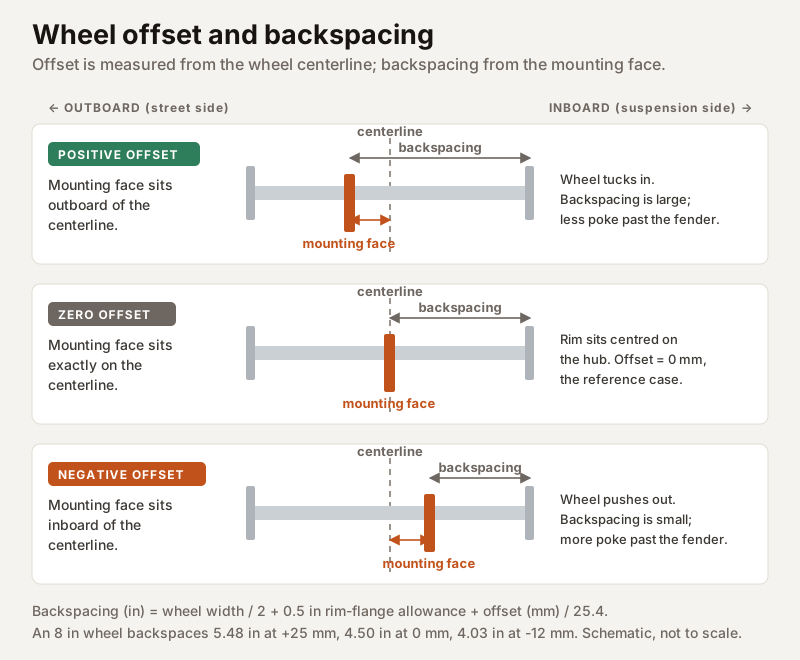
Offset matters more than any other number on an aftermarket wheel because it moves almost exactly one for one. Twenty-five millimeters is just under an inch (25.4 mm makes one), so dropping offset by 25 mm pushes the tire about an inch farther out - into the fender lip at full lock and onto a longer lever arm for the wheel bearings. Start from your truck's factory figure; the baseline varies enormously.
| Generation | Trim | Factory wheel | Offset |
|---|---|---|---|
| 3rd gen | SR / SR5 | 16x7 | +25 mm |
| 3rd gen | TRD Off-Road | 16x7 | +13 to +25 mm |
| 3rd gen | TRD Sport / Limited | 17-18x7.5 | +30 mm |
| 3rd gen | TRD Pro | 16x7.5 | +10 to +13 mm |
| 4th gen | SR / SR5 / TRD Off-Road | 17-18x7.5 | +55 to +60 mm |
| 4th gen | TRD Pro / Trailhunter | 18x8.5 | +20 to +25 mm |
That table explains a lot of confused forum threads. A fourth-gen SR5 starts around +55 to +60 mm and a third-gen TRD Pro around +10 to +13 mm, so one aftermarket wheel is a mild change on one truck and an aggressive one on the other. A spacer, meanwhile, is just a way of lowering effective offset by its own thickness.
Diameter: 16, 17, or 18 inches?
Wheel diameter does not decide how tall a tire you can run - overall diameter is rim plus two sidewalls, so a 33-inch tire exists on all three rim sizes. What it decides is how much of that height is rubber: grow the rim an inch and each sidewall gives up about half an inch.
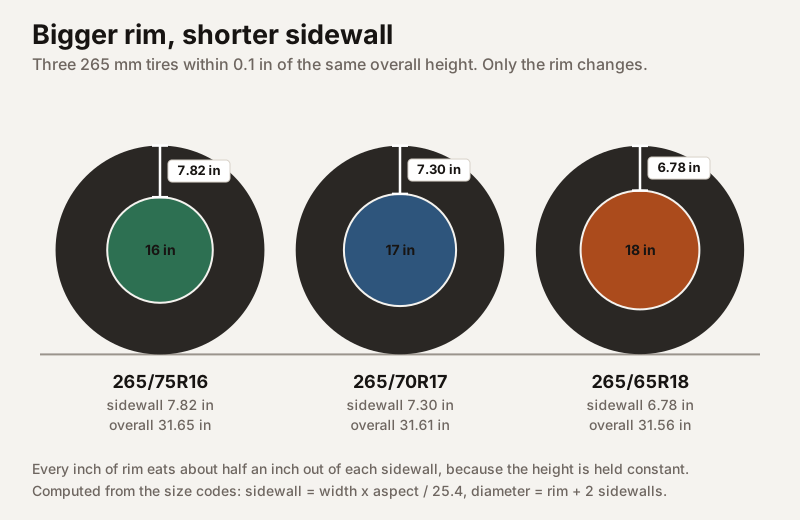
- 16 inch gives the most sidewall, the deepest air-down window, and the best rim protection - but new tire designs increasingly skip 16-inch molds, and a small wheel may not clear larger brakes.
- 17 inch is the usual off-road choice: the deepest tire catalog and plenty of sidewall, without the vague steering of a tall one.
- 18 inch trades sidewall for style, brake clearance, and sharper steering: fine for pavement and towing, a handicap on rock.
Width, and how it pairs with the tire
Wheel width is quoted in inches between the bead seats, and it matters for two reasons. Every tire size has an approved rim-width range published by its manufacturer, and mounting outside that range is not a judgement call - it is unsupported. And within that range, a wider rim pulls the sidewalls outward: the same tire measures slightly wider, stands slightly shorter, and puts its shoulder more squarely on the ground.
- Check the tire manufacturer's approved rim-width range for the exact size before you buy the wheel. The tire, not the wheel, publishes that constraint.
- A wider rim gives a squarer footprint and holds the bead better aired down; a narrower rim tucks the sidewall in and protects it against rock.
- Wheel width also moves the tire outward. Half of any extra width goes inboard toward the suspension and half goes outboard toward the fender, on top of whatever the offset is doing.
- Nominal section width from the size code is not measured width - a mounted tire measures differently by model and rim width, which is why fitment is confirmed on the truck, not on paper.
Load rating, weight, and the boring safety numbers
Every wheel carries a load rating - the maximum weight it is certified to support - stamped or documented by the manufacturer rather than inferred from how solid it looks. On a truck this is not a formality. The number to satisfy is your own axle rating, and the authority for that is the tire and loading information placard plus the owner's manual, not a vendor's marketing copy.
- Read the GAWR from the door placard and work out the per-wheel share for the heavier axle.
- Confirm the wheel's published load rating clears that share with margin - passenger-car-rated wheels exist in truck bolt patterns.
- Match the tire's own load index to the same requirement, with headroom for towing, a heavy bumper, or rock impact; a strong wheel under a weak tire solves nothing.
- Account for weight. A heavy wheel is unsprung and rotating mass, which costs acceleration, braking, and fuel every mile.
One item people forget until the light comes on: new wheels need TPMS sensors, and how painful that is depends on the generation. A third-gen truck cannot simply learn a second set of sensor IDs; a fourth-gen relearns through the dash after a short drive. Budget sensors and the relearn into the purchase.
A buying checklist
- Confirm the bolt pattern: 6x139.7 on every 6-lug Tacoma.
- Confirm hub bore and stud thread - 106.1 mm and M12x1.5 up to 3rd gen, 95.1 mm and M14x1.5 on 4th gen - and buy hub rings and lug nuts if you are crossing generations.
- Decide the overall tire diameter you want, then pick the rim diameter that gives you the sidewall you want under it.
- Choose width against the tire's published approved rim-width range.
- Model the offset against your factory figure and check the poke before you order, not after.
- Verify the wheel's load rating against your axle rating from the door placard.
- Budget TPMS sensors, a relearn, and a torque wrench - then re-torque after the first drive.
The best wheel is the one that clears everything
There is no universally best Tacoma wheel, and anyone who names one is selling something. There is a best wheel for your generation, tire size, brake package, and appetite for trimming - defined entirely by the numbers above. Get them right and the styling choice is finally just a styling choice.
Frequently asked questions
Every 6-lug Toyota Tacoma, first generation through fourth, uses 6x139.7 mm - six studs on a 139.7 mm bolt circle, also written 6x5.5 inches. Only early 2WD non-PreRunner models used 5x114.3. The pattern alone does not decide fit, though: hub bore is 106.1 mm through the third generation and 95.1 mm on the fourth, and the studs changed from M12x1.5 to M14x1.5.
On a first- through third-generation Tacoma, yes - the 4Runner, FJ Cruiser, GX, and first-generation Tundra share the 6x139.7 pattern and the 106.1 mm hub bore, so they bolt straight up and only offset is left to check. On a fourth-generation truck you also need a 106.1 to 95.1 mm hub-centric ring and M14x1.5 lug nuts.
The one closest to your factory figure that still clears the tire you want, because factory offset fits the widest tire with the least trimming. Baselines differ hugely: third-gen trims run roughly +10 to +30 mm while most fourth-gen trims run +55 to +60 mm. Every 25 mm you drop offset pushes the tire about an inch farther out, so model it before ordering.
Yes, unless your fitter moves your existing sensors onto the new wheels. A Tacoma uses a direct system with a sensor inside each wheel, so a bare aftermarket wheel has nothing to report pressure. A fourth-gen truck relearns new sensor IDs through the dash after a short drive; a third-gen cannot store a second set, so a spare wheel set needs an OBD relearn tool or cloned sensors.
Because we hold no wheel dataset. Our tire pages are scored from a 50-model research set with defined axes behind every claim, and we have no equivalent record of wheel load ratings, weights, or fitment outcomes. Naming best brands without that would be invention. What we can give you is the spec list any wheel has to satisfy on a Tacoma, which is what actually decides whether it fits.
Keep going
Sources
- Taco Tires wheel reference held in this repo - bolt pattern, hub bore, stud thread and lug torque by generation, plus factory offsets by trim, as used by the bolt pattern, offset and spacer calculators
- Taco Tires wheel-fitment math - backspacing = width/2 + 0.5 in flange allowance + offset, and a spacer as a one-for-one reduction in effective offset
- No wheel dataset exists on this site. Nothing here ranks or recommends a wheel brand, because we hold no load ratings, weights, or fitment records for aftermarket wheels
- Your vehicle's tire and loading information placard and owner's manual - the authority for axle ratings, lug torque, and what the truck is allowed to carry
Compare your exact sizes
Run any size in this guide through the Tacoma tire calculator to see diameter, width, speedometer error, effective gearing, and highway RPM before you buy.